Okay, so I just finished reading Heinlein's
Tunnel in the Sky and digging it. For those not familiar with the novel, basically it's Lord of the Flies in Space - in this universe, teens and young adults are offered a test if they want to venture out into the universe at large. They are sent to an unnamed planet not of their choosing and must survive for a short period of time. Something goes wrong, and they wind up on the planet for considerably longer...
Naturally, this set the gears in motion...
Thought question #1: What gunnie gear would you bring with you for the original purpose - a 1-2 stay on a completely unknown world?
You're going to an unfamiliar planet with unknown dangers, and can bring only which you can carry. What firearms would you bring; how much ammo; what other gear?
Though question #2: What would you bring for a longer period of time?
Obviously the key plot device is that they didn't know it would be much longer than the "2-10 days"; however disregard this and focus on what you would bring - that you could carry on your person - for an indeterminate amount of time. Figure about a year's time - long enough that things wearing out might be an issue, etc. How does this change your answer from Thought question #1?
Jay's Answer #1: For the short, set period of time, I'd opt for firepower and lots of it. Springfield Armory SOCOM II with red dot sight zeroed at 100 yards; lots and lots of loaded 20 round magazines. The .308 Winchester wouldn't be ideal for dangerous large game, but since this would be more for protection, it's a last-ditch defense. 20 rounds of .308 should take down most anything smaller than elephant, and with 15-20 loaded mags (2 per day), should have plenty of ammo but still be able to carry it. For a pistol, a Smith & Wesson Model 629 with 4" barrel in a sturdy leather belt holster would work nicely. Figure 200 rounds of hot .44 Magnum.
For the short period of time, hunting really wouldn't be a big issue - with sufficient preparation, enough food could be brought to last a week or so. Add in a moderate first aid kit, water purification equipment, and a spare change of clothes or two; figure two to three flashlights and spare batteries to last 2 weeks of 12 hours/day use; backpacking Coleman lantern & single burner stove for light cooking; flint & tinder for fire starting and as many Ohio Blue Tip matches as can safely be stored.
Jay's Answer#2. Here's where things get more problematic. Since it's going to be a long time, and it's possible that you might need your gun on a daily basis, we'll rule out all semi-autos. Because of the time involved, a .22LR is absolutely critical if for no reason other than being able to take a lot of ammo. Remington 572 Fieldmaster pump-action rifle would make an excellent companion - can take small game at ranges of 25 - 50 yards, is reliable all day long, holds 15 rounds in the tube, and requires only a minimum of cleaning to work every time you need it. Match it with a Smith & Wesson 617 10-shot .22LR with 6" barrel, and you've got a manually operated pair of firearms with 10-15K rounds of ammunition.
For centerfire ammo - protection as well as larger game harvesting - I'd favor also keeping ammo commonality. Figure a Marlin 1894 in .357 Magnum paired with a 7-shot S&W Model 686 with 6" barrel. With practice, the rifle will hit medium game out to 150 yards, the pistol an easy 50 yards. At close range, either will make all but the largest predators re-think having you for dinner. It's a trade-off, certainly - a .45/70 Guide Gun provides far more hitting power; a Rem 700 in 300 Magnum will take even large game easily at 2-300 yards. But being able to pack 1½-2K rounds of premium JSP ammo in the same space as 4-500 rounds of .300 Mag may mean the difference between eating well for 6 months and starving the rest and eating okay the whole year.
As for other gear, covering the basics would be a necessity - general antibiotics, and sturdy cooking gear; hardy axe and hatchet; trenching tool; as many matches as will fit and several different fire-starting methods as well (including magnifying glass, natch). Having to last for up to a year means that a stove/lantern would be an extravagance; a cast iron skillet to place over a roaring campfire would be far more practical.
I don't claim to be a survivalist; I'm certain that anyone even vaguely interested in long-term survival in the wild can poke all kinds of holes in my list-of-fancy. But heck, that's why I put it out there - there's a world of information out there, and I'm always eager to learn.
So what would y'all bring for both the short- and long-term?That is all.


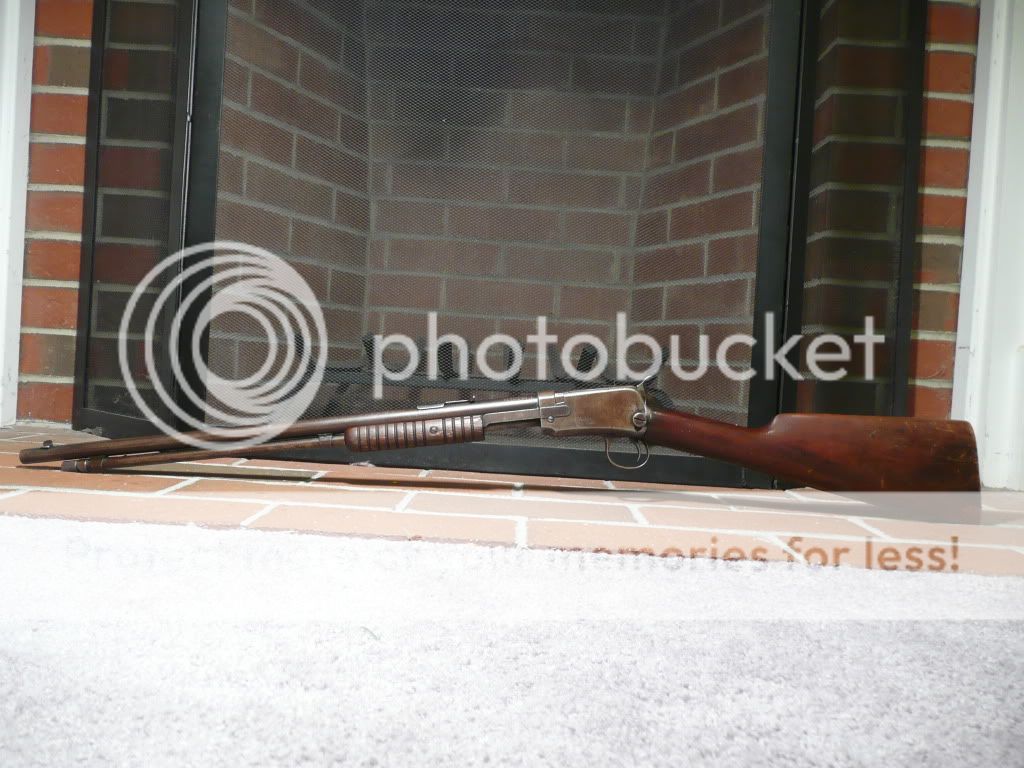
 What if Glock were to offer something like this, ready-made, using a G21 as a starting block? .45 ACP carbine, 13-15 round capacity, 16" barrel, with rail for optics and straight or folding stock? I have a feeling they literally would not be able to keep them on the shelves. I'd buy a G21 and as many 13 round magazines as I could get my grubby little mitts on if they came out with something like this for about the price of a Beretta CX4 Storm...