Showing posts with label MArooned Product Review. Show all posts
Monday, August 26, 2013
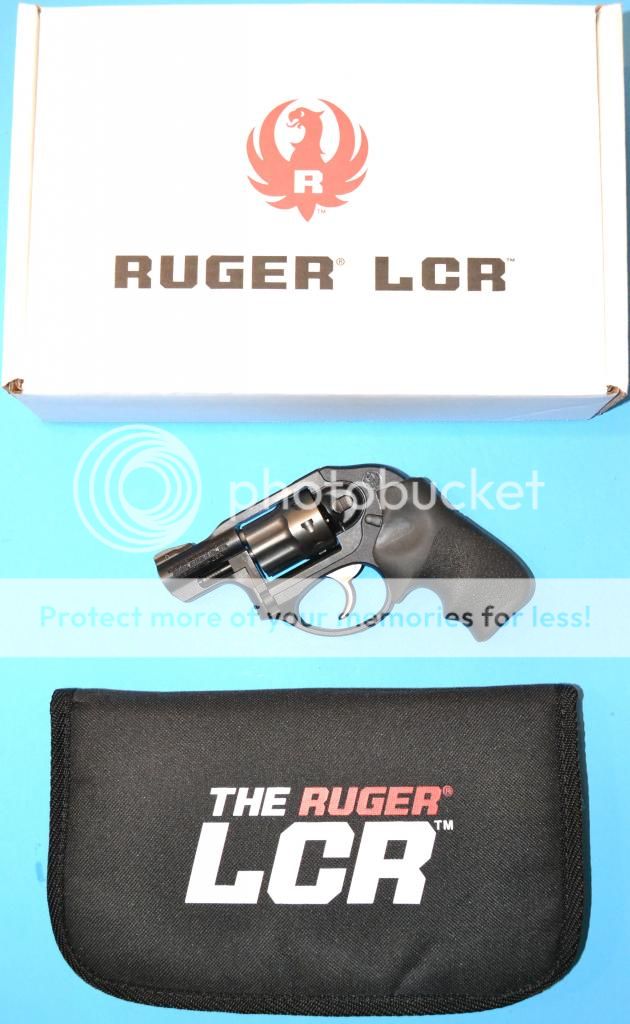
MArooned Product Review: Ruger LCR22
Last year I reviewed the LCR in .38 Special. This year, after seeing it get put on the Approved Firearms Roster {spit} I decided to try out the Ruger LCR22, the rimfire version of Ruger's groundbreaking short-barrel polymer revolver. I'm a huge fan of having a rimfire version of a firearm you carry every day, and in this case, the LCR22 is a carbon-copy of the LCR38 (with the obvious exception of the chambering, of course.
While the LCR in .38 Special is close to the Smith & Wesson counterpart in price, the same cannot be said for the LCR22. While the Smith & Wesson model 43 (hammerless airweight .22LR) checks in with an MSRP just under $700 ($689), the LCR22 is more than 20% less expensive. It's the same price as the LCR itself, whereas the centerfire counterpart to the 43, the 442, has an MSRP more than $200 less than its rimfire counterpart. It's hard enough to justify dropping $400 or more on a rimfire training pistol (especially since in recent times .22LR is selling for near centerfire prices...); it's even harder when the .22LR version is significantly more expensive.
Carrying the LCR22
While I don't really support carrying a defensive firearm chambered in .22LR, if for whatever reason one chose to carry one, I would recommend the LCR22 over pretty much any other rimfire handgun. I'd advocate for a revolver over a semi-automatic in .22LR for the simple reason that .22LR ammunition is naturally less dependable than centerfire ammunition. In a semi-automatic, if the round does not fire, then it becomes necessary to clear the firearm before the next round can be fired. In a revolver, one simply pulls the trigger again. The LCR22 is the most inexpensive revolver out there in .22LR, and its 8 round capacity is close enough to the 10-round capacity of the vast majority of semi-autos that the reliability is worth losing two rounds.
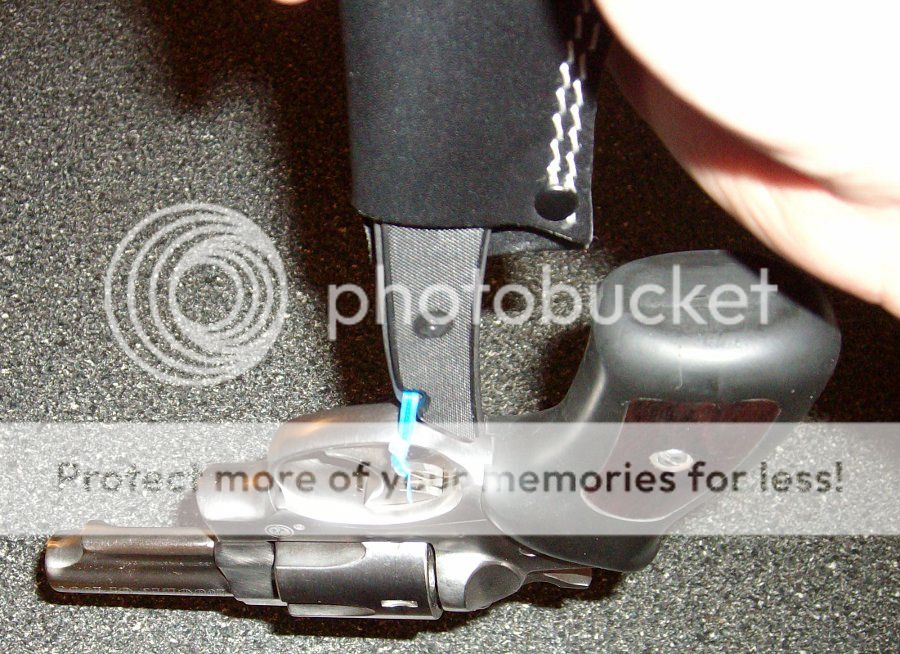
Should one decide to carry an LCR22, it will fit any holster that fits the LCR, which includes most holsters for the Smith & Wesson j-frame:
That's a Michael's Custom Holsters Executive II, which is my go-to holster when I carry a revolver concealed.
Ironically, the LCR22 weighs 1.4 ounces more than the LCR itself, tipping the scale at 14.9 ounces compared to the LCR's 13.5. If I were a betting man, I'd guess that extra weight is in the cylinder, in that the eight holes for .22LR don't remove as much raw metal as five holes for .38 Special. While I didn't carry the LCR22, I've been carrying the LCR pretty extensively for over a year and a half. I find it carries very well for a small revolver, and switching to the Crimson Trace
Shooting the LCR22.
The real surprise came when shooting the LCR22. Where it's a hammerless, short-barrel revolver, I expected the same "combat accuracy" (yeah, I said it, sue me) displayed by shooting J-frames and the LCR itself. It's certainly enough to get the job done, but you're not going to win any target matches without locking yourself in a range with a pallet of ammo and Novocaine for your wrist. However, the LCR22 surprised me:
That's two cylinders' worth of Federal bulk .22LR at 25 feet, shot offhand at maximum range speed (one shot per second). 16 rounds, and 10 of them are touching the 10-ring or better. The RSO walked over to check the target out when I was done shooting, and for a brief moment I shucked the "minute-of-berm" designation as he whistled appreciatively. And yes, I did pack it in after that target was shot - there was no way on G-d's Green Earth I was going to do better than that!
There's another use for the LCR22 that I realized during one range trip. It's a great introduction for new shooters who are curious about the snubnose revolver without dropping the Snubbie from Hell™ into their mitts. The low recoil and manageability allow the novice shooter to ease into shooting a small firearm, and get used to a tiny sight radius before dealing with significant recoil. The LCR22 has very little kick, and can be shot quite well - even by Jay "Minute of Berm" G.
There is one downside to this, though: I have confirmed that my inability to shoot the LCR as well has nothing to do with the LCR itself. It's obvious that a flinch caused by the anticipation of recoil is what's sending shots all over the paper in the centerfire LCR. Here's another area where the LCR22 can really help - take both to the range, and when the shots out of the LCR start to wander, switch to the LCR22 until the flinch disappears. Switch back to the LCR, practice until shots wander, then back to rimfire. Lather, rinse, repeat as necessary.
Conclusion
If you carry a snubnosed revolver, having a training version in .22LR is a great way to build up expertise in shooting the small handgun without breaking the bank (we're assuming, of course, that .22LR ever shows up on shelves again...). The LCR22 is nearly indistinguishable from the LCR in all but the recoil, and has Ruger's excellent DAO trigger to get more of your short-barrel shots on target to prepare you for the centerfire version.
If you're looking for a small rimfire revolver, the LCR22 is easily the best deal going.
That is all.
Monday, July 29, 2013
MArooned Product Review: SIG SAUER P238
So, a lot longer ago than I realized I received a SIG SAUER P238 for review:
That's the MA-compliant Nitron version (there are over 20 versions!) which comes with one magazine, a very cute kydex OWB holster (or IWB for lefties), a small tube of lube, and a chamber flag (along with several trees' worth of paper in the form of manuals, warnings, and other assorted legalese). It all comes in the standard SIG plastic lockable box, and this model comes with SIG's SIGLITE night sights.
The P238 is obviously influenced by the Colt Mustang. The design, controls, size; everything about the P238 is similar to Colt's 1911-based micro-380. Barrel length, overall length, and weight are very close to the littlest Pony; in fact, don't tell anyone, but I picked up a second magazine for the P238 - a Colt Mustang magazine - and it worked fine. Being a fan of the 1911, and also of the pocket pistol, the P238 was a natural fit for the armory.
Fit and finish on the P238 is top notch. The slide is done in SIG's Nitron finish, the frame is anodized black, and the grips are polymer (although I couldn't resist and found a nice pair of Hogue wood grips for it - much dressier!). While it weighs in at less than a pound loaded, it feels solid in the hand - not like you're trying to hang on for dear life. It's an excellent balance of light weight and usable size.
Carrying the P238
Obviously, a firearm this small is designed to be carried, and it was carried quite a bit. Some have issues with the idea of pocket-carrying a single-action only firearm with the hammer cocked on a loaded chamber, and while I can understand the issues, the safety on the P238 is very solid and did not move in all the time it was carried. It fits all the standard holsters that I have for pocket pistols:
It's in the molded kydex SIG holster, and under it are an Uncle Mike's #1 pocket holster, a Dragon Leatherworks Chimaera, and a DeSantis Nemesis pocket holster. The P238 fits in all three (although I will admit to bias towards the Chimaera, naturally) and doesn't carry any differently than the Smith & Wesson Bodyguard 380 that is normally in the Chimaera. The weight is within an ounce or so of the Bodyguard 380, and the dimensions are so close that they fit the same holsters.
Here's the P238 in comparison with two other pocket 380s:
Kel-Tec P3AT on the left and the Smith & Wesson Bodyguard 380 on the right. There's little appreciable difference in size between the three pistols, although the Kel-Tec is significantly lighter than the other two (and thinner). The P238 carries just fine in a pocket, and I saw no noticeable difference between it and the Bodyguard 380 when carried in a front or rear pocket.
Shooting the P238
What sets the SIG SAUER P238 apart from other pocket 380s is the single-action only trigger. It's much lighter than the DAO triggers of the other guns, which translates into less of a learning curve from a long pull, heavy trigger DOA. The size and heft of the P238 are well-suited for the 380 ACP - it's nowhere near as snappy in the P238 as in the P3AT - and it was much easier to shoot the P238 than even the Bodyguard 380. Up until I shot the P238, the BG 380 was my gold standard for "shootable" pocket 380s. It's still one of my faves, but the P238 is easier to shoot.
Not too shabby for a pocket pistol with a 2.7" barrel! That's at 25 feet with the magazine emptied as quickly as I could pull the trigger. Slower, more carefully aimed fire results in even tighter groups - and superior handgunners were able to shrink the 25' groups to a single ragged hole.
Reliability was excellent, with the only notable exception being the steel-cased Tulammo .380 ACP. I could not get the P238 to function with the Tulammo at all. All brass-cased ammunition, from Winchester White Box to Federal Hydra-shoks, fed, fired, and ejected reliably in the P238. It didn't seem to prefer any particular bullet shape - the flattened nose WWB worked just as well as the pointier hollowpoints and the standard round FMJ from Remington/UMC.
Recoil, while noticeable, was entirely manageable (although this is coming from someone that shoots a 12 ounce .357 Magnum, so consider the source). The P238 doesn't jump around between shots, making followup shots (a necessity for the marginal 380 round) much easier. The SIGLITE night sights are easy to use even in daylight, and while I didn't do any night shooting, they really do stand out in low light conditions (and they scared the HELL out of me the first time I opened the pistol safe...)
Cleaning the P238
Another pleasant surprise from the SIG SAUER P238 came at cleaning time. It's quite easy to take apart for cleaning: simply rack the slide so that the dimple behind the slide lock notch is over the edge of the slide release, push the pin out, and slide the slide off the frame. Remove the barrel and recoil spring, and it's ready for a scrubbing:
There's no pins to punch out (or have a hard time getting back in, yes, Smith & Wesson Bodyguard 380, I'm looking at yooooouuuu), it slides out with the push of your finger (or a pen cap or other non-marring pointy surface). Everything comes apart quickly and easily and goes back together the same way. It's entirely possible to clean this on the fly like a full sized gun.
Specifications (from SIG SAUER Spec sheet):
Item Number: 238-380-BSS, 238M-380-BSS
Caliber: .380 ACP (9mm short)
Action Type: SAO
Trigger Pull DA: N/A
Trigger Pull SA: 7.5-8.5 lbs
Overall Length: 5.5 in
Overall Height: 3.9 in
Overall Width: 1.1 in
Barrel Length: 2.7 in
Sight Radius: 3.8 in
Weight w/Mag: 15.2 oz
Mag Capacity: 6 Rounds
Sights: Contrast or SIGLITE Night Sights
Grips: Fluted Polymer Grips
Frame Finish: Black Hard Coat Anodized
Slide Finish: Nitron
Accessory Rail: No
Features: Beavertail style frame, fluted grips
MSRP: $679.00
Conclusion
The SIG SAUER P238 has an identity crisis. It's a small gun that thinks it's a full size gun. This might lead to problems for the P238 in schoolyard fights, with it picking on guns much larger than itself for caliber wars, but it makes for a pleasant shooting experience, a small gun that shoots like one much larger than itself. It's easy to carry, disappearing into a pocket or inside a waistband, with a size (and weight) suitable for having with you all day long.
There are less expensive pocket 380s out there, but none have the panache of a micro-1911 in your pocket!
That is all.
That's the MA-compliant Nitron version (there are over 20 versions!) which comes with one magazine, a very cute kydex OWB holster (or IWB for lefties), a small tube of lube, and a chamber flag (along with several trees' worth of paper in the form of manuals, warnings, and other assorted legalese). It all comes in the standard SIG plastic lockable box, and this model comes with SIG's SIGLITE night sights.
The P238 is obviously influenced by the Colt Mustang. The design, controls, size; everything about the P238 is similar to Colt's 1911-based micro-380. Barrel length, overall length, and weight are very close to the littlest Pony; in fact, don't tell anyone, but I picked up a second magazine for the P238 - a Colt Mustang magazine - and it worked fine. Being a fan of the 1911, and also of the pocket pistol, the P238 was a natural fit for the armory.
Fit and finish on the P238 is top notch. The slide is done in SIG's Nitron finish, the frame is anodized black, and the grips are polymer (although I couldn't resist and found a nice pair of Hogue wood grips for it - much dressier!). While it weighs in at less than a pound loaded, it feels solid in the hand - not like you're trying to hang on for dear life. It's an excellent balance of light weight and usable size.
Carrying the P238
Obviously, a firearm this small is designed to be carried, and it was carried quite a bit. Some have issues with the idea of pocket-carrying a single-action only firearm with the hammer cocked on a loaded chamber, and while I can understand the issues, the safety on the P238 is very solid and did not move in all the time it was carried. It fits all the standard holsters that I have for pocket pistols:
It's in the molded kydex SIG holster, and under it are an Uncle Mike's #1 pocket holster, a Dragon Leatherworks Chimaera, and a DeSantis Nemesis pocket holster. The P238 fits in all three (although I will admit to bias towards the Chimaera, naturally) and doesn't carry any differently than the Smith & Wesson Bodyguard 380 that is normally in the Chimaera. The weight is within an ounce or so of the Bodyguard 380, and the dimensions are so close that they fit the same holsters.
Here's the P238 in comparison with two other pocket 380s:
Kel-Tec P3AT on the left and the Smith & Wesson Bodyguard 380 on the right. There's little appreciable difference in size between the three pistols, although the Kel-Tec is significantly lighter than the other two (and thinner). The P238 carries just fine in a pocket, and I saw no noticeable difference between it and the Bodyguard 380 when carried in a front or rear pocket.
Shooting the P238
What sets the SIG SAUER P238 apart from other pocket 380s is the single-action only trigger. It's much lighter than the DAO triggers of the other guns, which translates into less of a learning curve from a long pull, heavy trigger DOA. The size and heft of the P238 are well-suited for the 380 ACP - it's nowhere near as snappy in the P238 as in the P3AT - and it was much easier to shoot the P238 than even the Bodyguard 380. Up until I shot the P238, the BG 380 was my gold standard for "shootable" pocket 380s. It's still one of my faves, but the P238 is easier to shoot.
Not too shabby for a pocket pistol with a 2.7" barrel! That's at 25 feet with the magazine emptied as quickly as I could pull the trigger. Slower, more carefully aimed fire results in even tighter groups - and superior handgunners were able to shrink the 25' groups to a single ragged hole.
Reliability was excellent, with the only notable exception being the steel-cased Tulammo .380 ACP. I could not get the P238 to function with the Tulammo at all. All brass-cased ammunition, from Winchester White Box to Federal Hydra-shoks, fed, fired, and ejected reliably in the P238. It didn't seem to prefer any particular bullet shape - the flattened nose WWB worked just as well as the pointier hollowpoints and the standard round FMJ from Remington/UMC.
Recoil, while noticeable, was entirely manageable (although this is coming from someone that shoots a 12 ounce .357 Magnum, so consider the source). The P238 doesn't jump around between shots, making followup shots (a necessity for the marginal 380 round) much easier. The SIGLITE night sights are easy to use even in daylight, and while I didn't do any night shooting, they really do stand out in low light conditions (and they scared the HELL out of me the first time I opened the pistol safe...)
Cleaning the P238
Another pleasant surprise from the SIG SAUER P238 came at cleaning time. It's quite easy to take apart for cleaning: simply rack the slide so that the dimple behind the slide lock notch is over the edge of the slide release, push the pin out, and slide the slide off the frame. Remove the barrel and recoil spring, and it's ready for a scrubbing:
There's no pins to punch out (or have a hard time getting back in, yes, Smith & Wesson Bodyguard 380, I'm looking at yooooouuuu), it slides out with the push of your finger (or a pen cap or other non-marring pointy surface). Everything comes apart quickly and easily and goes back together the same way. It's entirely possible to clean this on the fly like a full sized gun.
Specifications (from SIG SAUER Spec sheet):
Item Number: 238-380-BSS, 238M-380-BSS
Caliber: .380 ACP (9mm short)
Action Type: SAO
Trigger Pull DA: N/A
Trigger Pull SA: 7.5-8.5 lbs
Overall Length: 5.5 in
Overall Height: 3.9 in
Overall Width: 1.1 in
Barrel Length: 2.7 in
Sight Radius: 3.8 in
Weight w/Mag: 15.2 oz
Mag Capacity: 6 Rounds
Sights: Contrast or SIGLITE Night Sights
Grips: Fluted Polymer Grips
Frame Finish: Black Hard Coat Anodized
Slide Finish: Nitron
Accessory Rail: No
Features: Beavertail style frame, fluted grips
MSRP: $679.00
Conclusion
The SIG SAUER P238 has an identity crisis. It's a small gun that thinks it's a full size gun. This might lead to problems for the P238 in schoolyard fights, with it picking on guns much larger than itself for caliber wars, but it makes for a pleasant shooting experience, a small gun that shoots like one much larger than itself. It's easy to carry, disappearing into a pocket or inside a waistband, with a size (and weight) suitable for having with you all day long.
There are less expensive pocket 380s out there, but none have the panache of a micro-1911 in your pocket!
That is all.
Wednesday, July 10, 2013
MArooned Product Review: TacPro Gear Covert Go-Bag
So, a while back I received a Covert Go-Bag from TacProGear for review. I took it to the NRA convention in Houston in May, and have used it on other journalistic-type forays as well. Figured it was as good a time as any to post a full review, so here goes!
First off, let's address one of the points brought up in comments to my initial post:
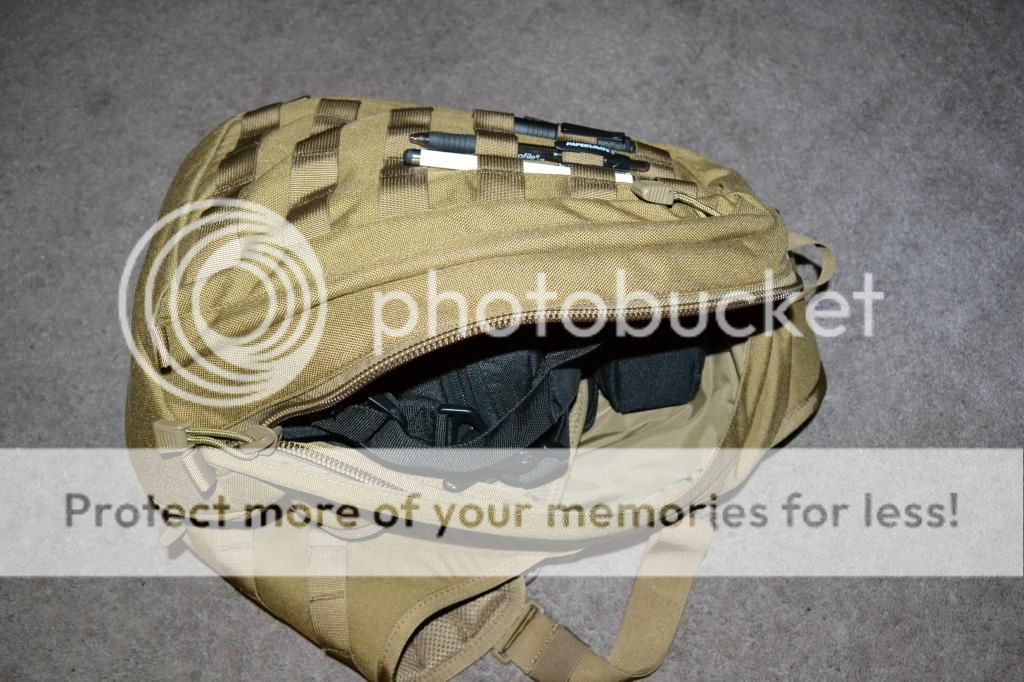
It's not terrifically "covert" in the grand scheme of things. This is obviously a martially-geared piece of equipment, from the different straps to the webbing to the color. Using the webbing as a pen/pencil/stylus/flashlight holder tends to distract from the overall tactical application, and generally the bag doesn't draw so much as a second glance.
Not even using it as a "personal item" at Logan Airport...
It holds a pretty decent complement of gear:
There's my iPad, full camera case, and HandyCam, everything I need to tackle the NRA convention. In the inside zippered pocket are headphones, spare batteries, and power cords as well as cleaning cloth. It's really not designed for large, bulky items like the full camera case, so getting it closed required a bit of creative adjustment, but it worked.
Plus it has a special secret pocket:
It has a "wheel" - with straps to hold a firearm and magazine on one side and velcro for the inside of the pocket on the other. It's fully adjustable for any size or type of firearm, and the pocket is large enough for a full-size handgun. That's the LaserLyte Trigger Tyme pistol being used as a - pardon the cliché - blue gun.
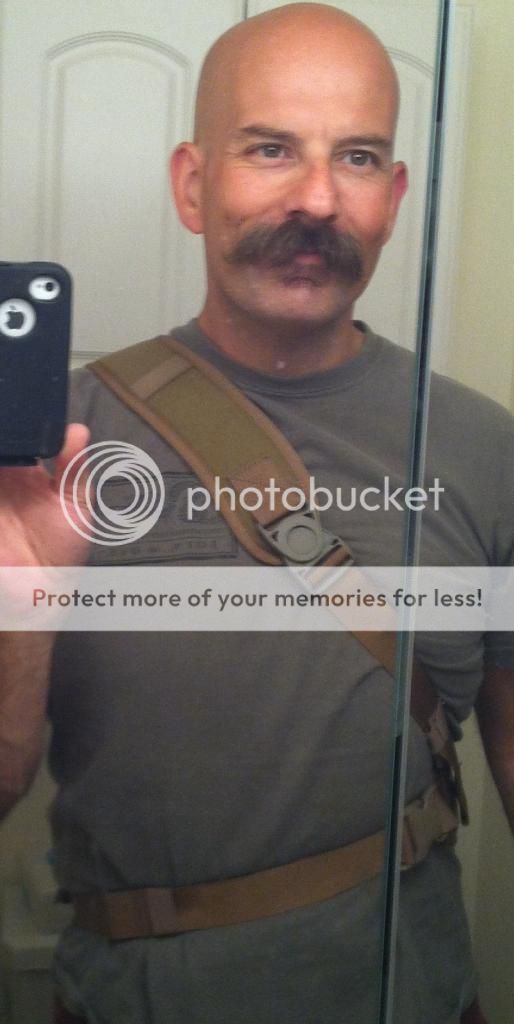
So, it holds a lot of gear. How's it carry, you ask? Pretty well (once you get the straps adjusted and everything figured out - thanks #1 blogdaughter!):
It tucks in nice and snug to the body, that's the distinct advantage to this pack. I had no trouble maneuvering through the intense crowd at the NRA convention with the Covert Go-Bag. The attachment points are simple and easy to operate:
There's a quick release buckle that cuts across the stomach, and another clip at the shoulder:
I found that releasing the waist buckle was sufficient to get the pack off, although if needed both the buckle and the clip can be released nearly instantly if you need to get the pack off in a hurry. Getting it back on is as simple as swinging it over your shoulder and clipping the shoulder, then buckling at the waist. The strap at the top is a holder for a hydration system, which is pretty sweet.
And, lastly, the view from behind:
Sorry about the crappy cell phone pictures here. It's REALLY hard to set up self-shots quickly. As you can see, though, the pack sets squarely in the back and distributes the weight evenly. The side braces even rest on top of the super-strong Dragon Leatherworks belt!
For a small, light pack that'll fit a decent amount of gear, the Covert Go-bag is an excellent option. It's not as pricey as the Maxpedition packs, yet doesn't feel like they cut any corners. It survived being banged around the NRA convention, one of the most crowded venues I've been to, as well as modern air travel - twice - and countless trunks. It's well-padded to keep your gear safe and will hold everything you need for a day's outing (remember a poncho, just in case!).
TacProGear Covert Go-Bag - might be misnamed on the Covert side, but the Go part is spot-on!
That is all.
First off, let's address one of the points brought up in comments to my initial post:
I find the "covert" name to be misleading because nothing says covert like coyote (desert) brown and molle webbing all over.Well, yeah:
It's not terrifically "covert" in the grand scheme of things. This is obviously a martially-geared piece of equipment, from the different straps to the webbing to the color. Using the webbing as a pen/pencil/stylus/flashlight holder tends to distract from the overall tactical application, and generally the bag doesn't draw so much as a second glance.
Not even using it as a "personal item" at Logan Airport...
It holds a pretty decent complement of gear:
There's my iPad, full camera case, and HandyCam, everything I need to tackle the NRA convention. In the inside zippered pocket are headphones, spare batteries, and power cords as well as cleaning cloth. It's really not designed for large, bulky items like the full camera case, so getting it closed required a bit of creative adjustment, but it worked.
Plus it has a special secret pocket:
It has a "wheel" - with straps to hold a firearm and magazine on one side and velcro for the inside of the pocket on the other. It's fully adjustable for any size or type of firearm, and the pocket is large enough for a full-size handgun. That's the LaserLyte Trigger Tyme pistol being used as a - pardon the cliché - blue gun.
So, it holds a lot of gear. How's it carry, you ask? Pretty well (once you get the straps adjusted and everything figured out - thanks #1 blogdaughter!):
It tucks in nice and snug to the body, that's the distinct advantage to this pack. I had no trouble maneuvering through the intense crowd at the NRA convention with the Covert Go-Bag. The attachment points are simple and easy to operate:
There's a quick release buckle that cuts across the stomach, and another clip at the shoulder:
I found that releasing the waist buckle was sufficient to get the pack off, although if needed both the buckle and the clip can be released nearly instantly if you need to get the pack off in a hurry. Getting it back on is as simple as swinging it over your shoulder and clipping the shoulder, then buckling at the waist. The strap at the top is a holder for a hydration system, which is pretty sweet.
And, lastly, the view from behind:
Sorry about the crappy cell phone pictures here. It's REALLY hard to set up self-shots quickly. As you can see, though, the pack sets squarely in the back and distributes the weight evenly. The side braces even rest on top of the super-strong Dragon Leatherworks belt!
For a small, light pack that'll fit a decent amount of gear, the Covert Go-bag is an excellent option. It's not as pricey as the Maxpedition packs, yet doesn't feel like they cut any corners. It survived being banged around the NRA convention, one of the most crowded venues I've been to, as well as modern air travel - twice - and countless trunks. It's well-padded to keep your gear safe and will hold everything you need for a day's outing (remember a poncho, just in case!).
TacProGear Covert Go-Bag - might be misnamed on the Covert side, but the Go part is spot-on!
That is all.
Monday, June 24, 2013
MArooned Book Report: "American Gun", by Chris Kyle
So, a few weeks back I received my copy of "American Gun" by Chris Kyle:
It immediately went into the queue, and as soon as I finished "World War Z", I started "American Gun". I finished it at the end of last week and wanted to post a review for the curious.
Kyle lists ten firearms that he considers uniquely American and integral to the history of the American firearms experience. Most are pretty much what you'd expect" Colt 1911, M16, M1 Garand, Winchester 1873 lever action, Peacemaker. Kyle devotes a full chapter to each firearm, discussing the events that led up to the gun's introduction as well as the impact the firearm had on the course of American history as well as in world history.
I found it to be an excellent read; Kyle approaches the subject with a warrior's eye, but you can tell he's having a lot of fun with this as well. His writing style is pretty unique; he's both laid back and intense at the same time, and makes his case with both anecdote and hard data. Kyle weaves American history, legend, and lore together in a truly interesting book, and makes his case for each of the ten firearms convincingly.
There's a few surprises on the "Top Ten" list, and a few more that are surprising by their absence. That's not to say that the ten on the list aren't excellent American firearms, iconic in their own right, of course; just that out of all the American firearms that have been made in the history of our country, narrowing the list down to only ten is a herculean task. Chris Kyle has done a masterful job of narrowing the list down, defending his choices, and getting the reader to see his point.
I'd recommend this book to anyone with an interest in firearms, American history, and - especially and - both together. I'll be ordering Chris Kyle's "American Sniper" next, that's how much I like his writing style. It's an easy read, but that doesn't mean simple; just that he presents his material without a lot of extra words, and he doesn't throw in big words just to sound smart. He lets his writing do that for him.
The only thing I don't like about this book is that I can never have a signed copy. Rest in Peace, Chris.
That is all.
That is all.
It immediately went into the queue, and as soon as I finished "World War Z", I started "American Gun". I finished it at the end of last week and wanted to post a review for the curious.
Kyle lists ten firearms that he considers uniquely American and integral to the history of the American firearms experience. Most are pretty much what you'd expect" Colt 1911, M16, M1 Garand, Winchester 1873 lever action, Peacemaker. Kyle devotes a full chapter to each firearm, discussing the events that led up to the gun's introduction as well as the impact the firearm had on the course of American history as well as in world history.
I found it to be an excellent read; Kyle approaches the subject with a warrior's eye, but you can tell he's having a lot of fun with this as well. His writing style is pretty unique; he's both laid back and intense at the same time, and makes his case with both anecdote and hard data. Kyle weaves American history, legend, and lore together in a truly interesting book, and makes his case for each of the ten firearms convincingly.
There's a few surprises on the "Top Ten" list, and a few more that are surprising by their absence. That's not to say that the ten on the list aren't excellent American firearms, iconic in their own right, of course; just that out of all the American firearms that have been made in the history of our country, narrowing the list down to only ten is a herculean task. Chris Kyle has done a masterful job of narrowing the list down, defending his choices, and getting the reader to see his point.
I'd recommend this book to anyone with an interest in firearms, American history, and - especially and - both together. I'll be ordering Chris Kyle's "American Sniper" next, that's how much I like his writing style. It's an easy read, but that doesn't mean simple; just that he presents his material without a lot of extra words, and he doesn't throw in big words just to sound smart. He lets his writing do that for him.
The only thing I don't like about this book is that I can never have a signed copy. Rest in Peace, Chris.
That is all.
That is all.
Monday, April 22, 2013
MArooned Product Review: Kel-Tec SUB-2000
Yeah, this review is a little bit overdue. I've had the SUB-2000 for a while now, and I've really had a chance to put it through its paces. The scarcity of 9mm, though, has been the limiting factor - for the past five months I have not been able to find so much as one box. It's pretty ironic, in that one of the big reasons for choosing the 9mm variant is the (normally) easy availability of 9mm ammunition.
The SUB-2000 is immediately recognizable by the folding mechanism:
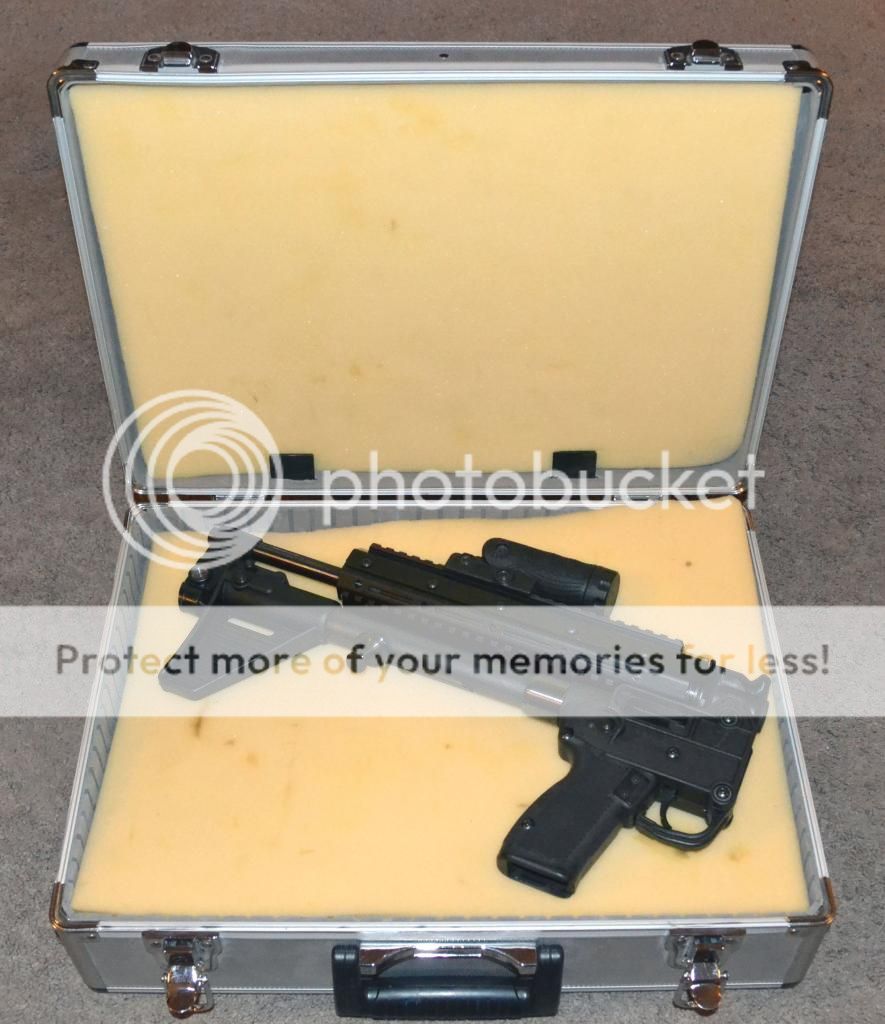
It's ingeniously simple - to open the SUB-2000, there's a sliding pin near the front sight that you pull to the rear. The carbine opens up in a couple seconds, it's really that simple. To close it, simply pull down the trigger guard (like taking down a Makarov) and it folds in half. Naturally, I had to pretend I was 007 and put it in a briefcase:
Okay, so it's not a briefcase, but you get the idea. That's case I normally use for transporting handguns, and the SUB-2000 fits even with the folding foregrip attached (that's a TFL from the Mako Group, for the curious; it arrived in a shipment with the TAL-4 grip I tested for my Shooting Illustrated article on foregrips last year). Rumors that, upon removing the SUB-2000 from the case and opening it up I was heard to exclaim, "G. Jay G. License to kill" are exaggerated...
The SUB-2000 is set up to take many common handgun magazines. The most common is the ubiquitous Glock 17, of course, as well as the 19; there's also a variant set up to take Smith & Wesson model 59 magazines (I would imagine because the P11 takes them as well) and also the Beretta 92. This particular model is set up for SIG SAUER P226 magazines, since I happen to own a P226 and quite a few pre-ban magazines for it. This allows for a great degree of customization as well as offering an excellent way to manage a pistol/carbine combination utilizing not just the same ammunition but even magazines, too.
The one adjustment I made to the SUB2000 was adding the railed forend, an accessory available from Kel-Tec, although there are other rails available (Oleg mentioned one that has a rotating section so you can still fold the SUB2000 with an optic attached. Sure wish I could remember who made it...). It attaches quickly and easily, although it could use a drop or two of Loctite, as it tends to work a little loose after a session at the range.
And speaking of the range, I was quite surprised by the performance of the SUB2000 at the range. On the pistol range at my gun club, even the 25 yard distance proved easy - only three rounds of out 15 outside of the inner 4" ring:
Yeah, at 50 feet it wasn't even a challenge - the rounds just go where you want them to. I brought the SUB2000 to Brad_in_MA's range where we put up a 10" steel plate on the 100 yard berm, and hitting that with the SUB2000 was shockingly easy - although, again, there's a slight delay between the [bang] and the [ting] that's unnerving (but certainly not the SUB2000's fault!). Even with the rudimentary sights - the front post is a clear plastic tab with a red tint; the rear sight is a small, simple peep sight. But hey, the proof is in the targets - rudimentary or not, the sights just work.
The trigger surprised me, in that it was pretty clean and smooth - my only other frame of reference for Kel-Tec triggers is my P3AT, which is, let me be charitable, less-than-pleasant. Recoil, since it's a pistol-caliber carbine, is quite manageable - keeping the SUB2000 on target even under rapid-fire shooting is very easy. It's light, works every time, and hits where you point it - basically, it does everything you want a pistol caliber carbine to do at a price that's quite reasonable (MSRP is $409).
Reliability is one area where the SUB-2000 really surprised me - in a good way. I've had good luck with my P3AT - aside from needing a little *push* to get the slide into battery once in a while, it has been very reliable with both FMJ and JHP ammunition. I fed the SUB-2000 a constant diet of bulk 115 grain FMJ and did not experience a single malfunction of any type; the only issues it had were with the Remington UMC 115 grain JHP bulk pack. Winchester White box FMJ, Remington FMJ, old Blazer Brass FMJ, Pierce FMJ; it fed every single FMJ round I put into it as well as the Federal Hi-Shoks.
In conclusion, I have to admit that I was very pleasantly surprised by the SUB-2000. It handled well, shot great, worked perfectly with most ammo, and in general did everything you'd want a pistol caliber carbine to do. It's light, low-recoil, and handy - this is something you can leave in a trunk or behind a rear seat in a pick up and have over 50 rounds at the ready (most configurations have anywhere from 15 - 20 round magazines available). While I know the argument that all pistol calibers suck from a stopping standpoint, having 15 rounds that will go into a small circle even out to 25 yards is an argument with which it is hard to argue.
Kel-Tec SUB-2000: Just as much fun as an Uzi carbine at a quarter the cost...
That is all.
Thursday, April 18, 2013
MArooned Product Review Follow-up: Dragon Leatherworks Belt
Okay, we're rapidly coming up on a third of a year with the kick-ass belt I got from Dragon Leatherworks. I have been wearing the crap out of this thing, and I'll tell you, it just keeps looking as good as when I first got it. It's been around my waist for ~ 10 - 12 hours a day 7 days a week for a while now - I think I'd already broken my first 5.11 belt by this point. My initial review was two months ago, only a month or so after getting the belt, and I've had a lot more time to wear it and see how it held up.
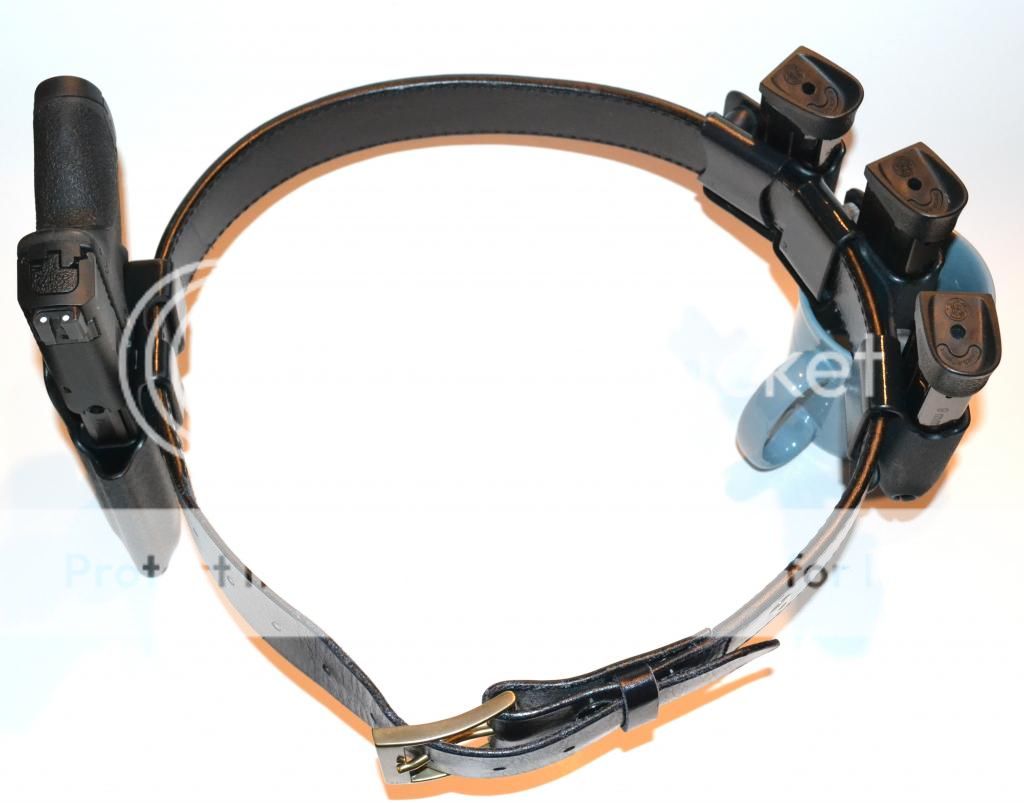
Oh, yeah, there's also the fact that I wore this belt to the Fundamentals of Combat Focus Shooting class I took courtesy of Down Range Firearms Training last month. I strapped on the Dragon Leatherworks belt at 7 in the morning with all this gear:
and didn't take it off for over 12 hours. I weighed it - over three and a half pounds of gear there. Doesn't seem like much until you strap it to your waist and run all over hell and creation for the better part of an entire day.
When they say that the right belt makes all the difference, that's not hyperbole. The Dragon Leatherworks belt held all that gear (well, minus the coffee mug, but I did have at least double that amount of coffee in me) all day long. Not only that, it actually made it comfortable. A Kydex OWB holster with a Smith & Wesson M&P and three Comp-Tac mag holsters, each with a fully loaded magazine - all day, all over the place. The belt made it easy, and that's no small feat.
I can't imagine taking a course like this with any other belt - thanks, Dennis!
That is all.
Oh, yeah, there's also the fact that I wore this belt to the Fundamentals of Combat Focus Shooting class I took courtesy of Down Range Firearms Training last month. I strapped on the Dragon Leatherworks belt at 7 in the morning with all this gear:
and didn't take it off for over 12 hours. I weighed it - over three and a half pounds of gear there. Doesn't seem like much until you strap it to your waist and run all over hell and creation for the better part of an entire day.
When they say that the right belt makes all the difference, that's not hyperbole. The Dragon Leatherworks belt held all that gear (well, minus the coffee mug, but I did have at least double that amount of coffee in me) all day long. Not only that, it actually made it comfortable. A Kydex OWB holster with a Smith & Wesson M&P and three Comp-Tac mag holsters, each with a fully loaded magazine - all day, all over the place. The belt made it easy, and that's no small feat.
I can't imagine taking a course like this with any other belt - thanks, Dennis!
That is all.
Thursday, February 28, 2013
MArooned VIDEO Product Review: TerraLUX TT-1 and TT-5 Flashlights
Before SHOT Show last month, I received a TerraLUX TT-5 flashlight for review. I chatted with the folks at TerraLUX at SHOT (there's a video I'm waiting to post there) and shortly thereafter a TT-1 showed up as a companion to the TT-5.
After having both flashlights for a while, I decided it was time to post a quick review. Seeing as how these are pretty flippin' awesome flashlights, though, I decided that mere photographs weren't going to cut it. No, I thought; these flashlights kick so much @$$ that they needed a video review. So I grabbed my Handycam, put the camera on a tripod, and retreated to a (somewhat) dark corner to bring you this:
I had another video where I compared both TerraLUX flashlights against other LEDs I have, but, honestly, the video sucked. I stood behind the camera and it was pointed at a door the whole time, and while you could see the difference in illumination, quite frankly it was as boring as watching paint dry. My respect for YouTubers grows every time I make a video.
I'll see if I can't get it right the next time I drag out the video camera and post a followup video shortly. I'll get some pictures, as well: both of these lights throw an amazing amount of light (note to self: Get a picture of the backyard at night). I've been carrying the TT-1 around, and for the size it's like stuffing a miniature sun in your pants. Wait. That probably sounds a lot worse than I meant...
I'll have a more in-depth review with the expanded video, but I wanted to get up the basic starter review now. I'm impressed with the clean, bright light put out by both TerraLUX flashlights, as well as the simple operation and rugged build. The TT-1 is a great size for EDC, and the TT-5 is really great on the nightstand or clamped on your favorite home defense firearm (and bright enough to roast the goblin if they're at bad-breath distance). Oh, and on a side note, I was mistaken about the strobe feature - if you push the strobe button and hold it for 2 seconds it will stay on.
More in-depth review to follow, but I am quite impressed with the offerings from TerraLUX thus far.
That is all.
After having both flashlights for a while, I decided it was time to post a quick review. Seeing as how these are pretty flippin' awesome flashlights, though, I decided that mere photographs weren't going to cut it. No, I thought; these flashlights kick so much @$$ that they needed a video review. So I grabbed my Handycam, put the camera on a tripod, and retreated to a (somewhat) dark corner to bring you this:
I had another video where I compared both TerraLUX flashlights against other LEDs I have, but, honestly, the video sucked. I stood behind the camera and it was pointed at a door the whole time, and while you could see the difference in illumination, quite frankly it was as boring as watching paint dry. My respect for YouTubers grows every time I make a video.
I'll see if I can't get it right the next time I drag out the video camera and post a followup video shortly. I'll get some pictures, as well: both of these lights throw an amazing amount of light (note to self: Get a picture of the backyard at night). I've been carrying the TT-1 around, and for the size it's like stuffing a miniature sun in your pants. Wait. That probably sounds a lot worse than I meant...
I'll have a more in-depth review with the expanded video, but I wanted to get up the basic starter review now. I'm impressed with the clean, bright light put out by both TerraLUX flashlights, as well as the simple operation and rugged build. The TT-1 is a great size for EDC, and the TT-5 is really great on the nightstand or clamped on your favorite home defense firearm (and bright enough to roast the goblin if they're at bad-breath distance). Oh, and on a side note, I was mistaken about the strobe feature - if you push the strobe button and hold it for 2 seconds it will stay on.
More in-depth review to follow, but I am quite impressed with the offerings from TerraLUX thus far.
That is all.
Monday, February 25, 2013
MArooned Product Review: Ruger 22/45 Lite
So, I've had the Ruger 22/45 Lite for a while now, and figured it was about time to give it a proper review. The good folks at Sturm, Ruger & Co. were kind enough to send a model to me towards the end of the summer, just in time for fall shooting and winter indoor practice. My gun club has a small indoor range under the clubhouse with a simple angled steel plate that deflects rounds into a sand trap, and is limited to lead bullets only. This means that for the colder months of the year I'm shooting a lot more .22LR.
Which, given the recent ammo shortage and price increases, would have been happening anyways...
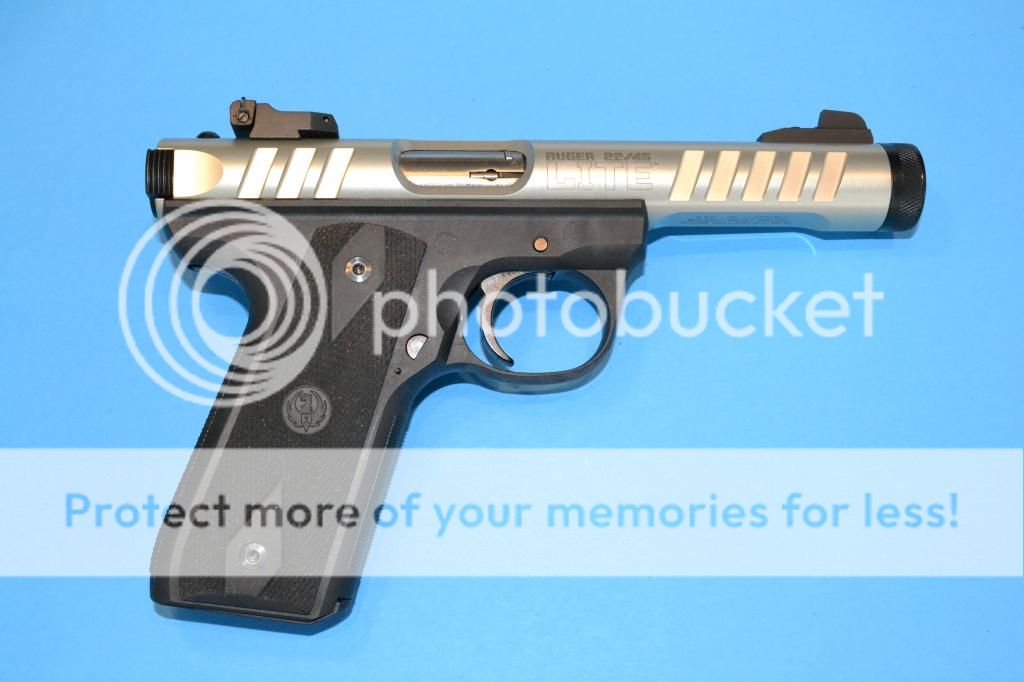
The 22/45 was designed in 1992 as a rimfire trainer for the 1911 (interesting to note, of course, that Ruger's 1911 wouldn't be introduced for nearly two decades). The 22/45 has the same grip angle and control location as the 1911 (slide release, magazine release, and safety), and some models have removable grip panels that are quite similar to the 1911. The 22/45 Lite even goes so far as to add in the cocking serrations, although I don't recommend trying them unless you want funny looks at the range (ahem)...
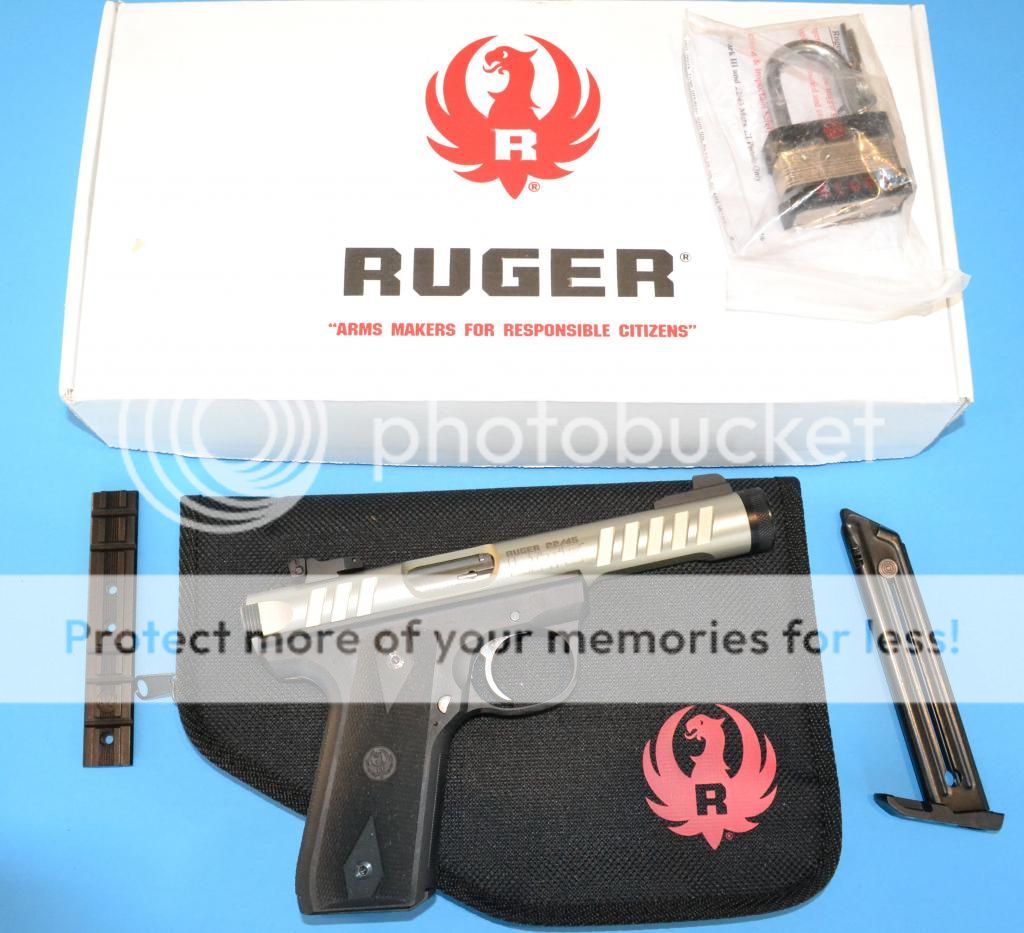
Here's what arrives with the 22/45 Lite:
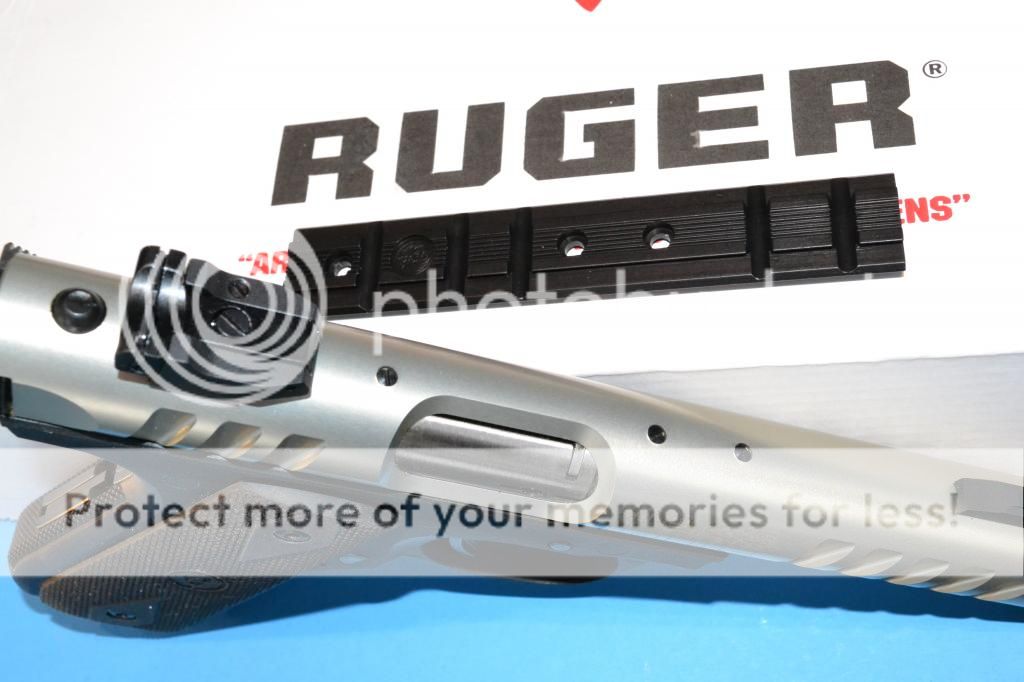
There's two magazines, the infamous Ruger lock, a nylon pistol case, and a rail:
That's mighty slick right there, I do have to admit. Remove the three screws from the top, position the rail, tighten it down (Ruger provides slightly longer screws, even). Looks like the process might take two or three minutes. I'm tempted to put it on, because this gun just cries out for a nice red dot or reflex sight, however it defeats the purpose of having the Lite if additional gear is going to be added. Then again, putting on a small red dot sight would bring the total weight to that of the standard 22/45...
The weight of the 22/45 Lite is the big selling point, of course. The aluminum receiver assembly shaves more than half a pound off the weight of the 22/45 - the steel assembly tips the scales at 32 ounces even; the Lite comes in at a svelte 22.8 ounces. Those 9.2 ounces aren't missed in felt recoil - this is .22LR we're talking about - but if you're teaching a new shooter, they make a world of difference when the new person has been holding the gun getting used to it for a while.
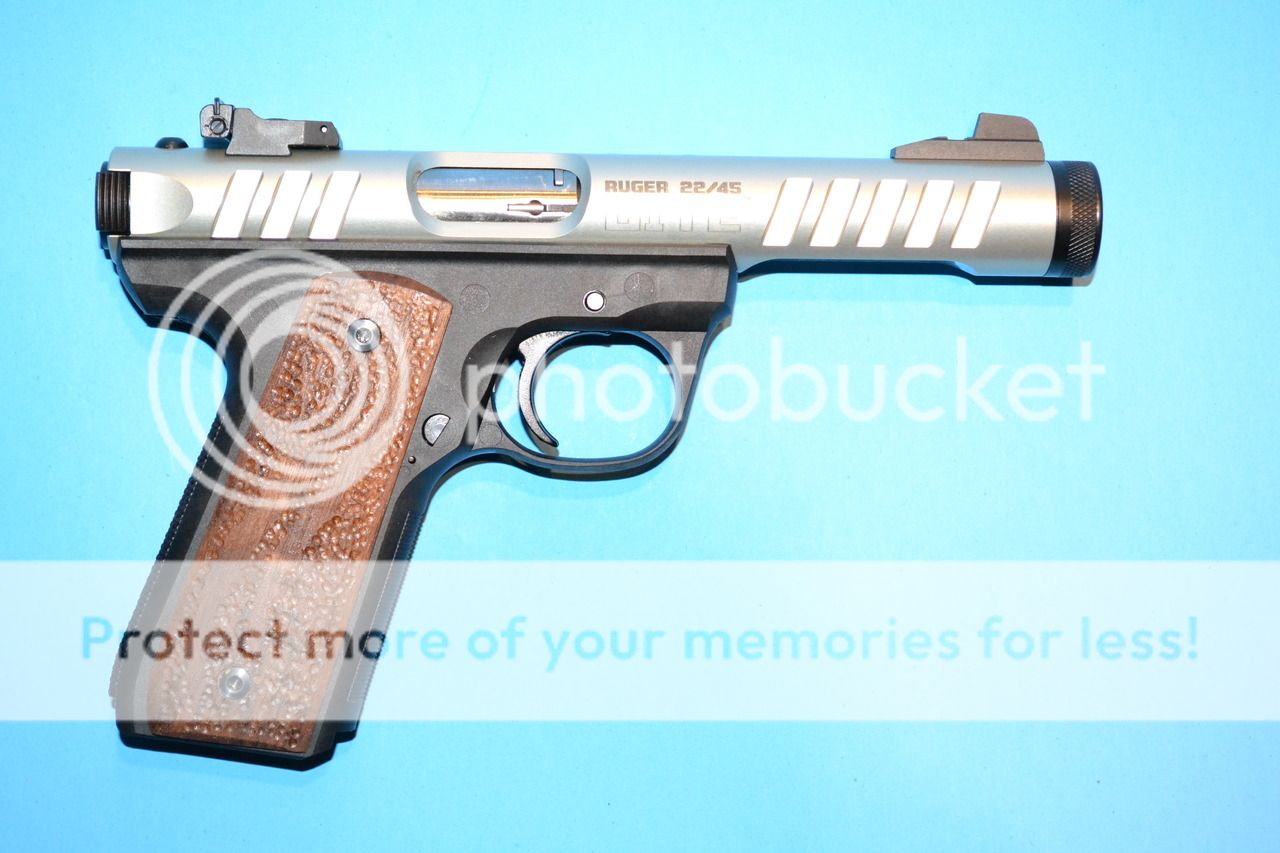
This model also has the changeable grip panels, which means that you can upgrade the rubber grips for nice wooden grips, like those made by Rimfire Designs:
as seen here. This is a nice feature that allows for some customization. Also evident on this model is the threaded barrel, which would be a much more useful feature for someone in a state that allows suppressors. That's another advantage to the lighter weight; adding a suppressor to the 22/45 Lite generally won't even bring the overall weight up to that of the steel version.
What did I like about the 22/45 Lite:
Well, first and foremost, how it shot, but I'll save that for the end. Now, I'm an unabashed fan of the 1911 platform, so I really like how the 22/45 is modeled after the iconic autoloader designed by John Moses Browning (PBUH). The option of adding on a rail for optics is nice to have, and will allow for all sorts of different options down the road. The changeable grip panels are also nice, allowing for a chance in look and feel if one so desires.
The weight on the 22/45 is just about perfect. It's light enough that if you want to add a red dot sight or a suppressor you're not hefting around a three pound rimfire gun, yet it's not so light that it would be off-putting to a new shooter. This is a fantastic gun for starting out a new shooter because of the weight - a great balance between being able to hold it for an extended period of time and enough heft to damper recoil for novice shooters.
Mechanically the 22/45 is exactly what you'd expect from Ruger. It's built like a tank, runs exceptionally well, and is more accurate than I am. I didn't take the 22/45 down once in the time I had it - just ran a boresnake down the barrel, wiped the bolt clean as best I could, and oiled the bolt - and it still ran great. It fed nearly everything I put into it - it HATED PMC Sidewinder - and, best of all, ran my beloved Federal bulk 36 grain CPHP like nobody's business. Yes, like pretty much ever .22LR pistol I've ever shot, after a couple hundred rounds it starts getting dirty and having feeding issues, but until it gets to that point it runs like a clock.
What I don't particularly care for about the 22/45 Lite:
Magazine disconnect. Okay, so they more or less come standards with all Ruger autoloaders; that doesn't mean I have to like them. I find mag disconnects to be pointless and stupid, and simply another part to break. Must look into removing it. Loaded chamber indicator. Okay, so this one is required for MA compliance, but man, a pop-up timer ... out the side? Really? I thought the pop up flag coming off the top of the slide was silly on the LC9 and the SR9; on the 22/45 it comes off opposite the ejector port. It's no big deal, mind you; mere aesthetics, but it was somewhat distracting to see it hanging off the side there.
Shooting the 22/45 Lite:
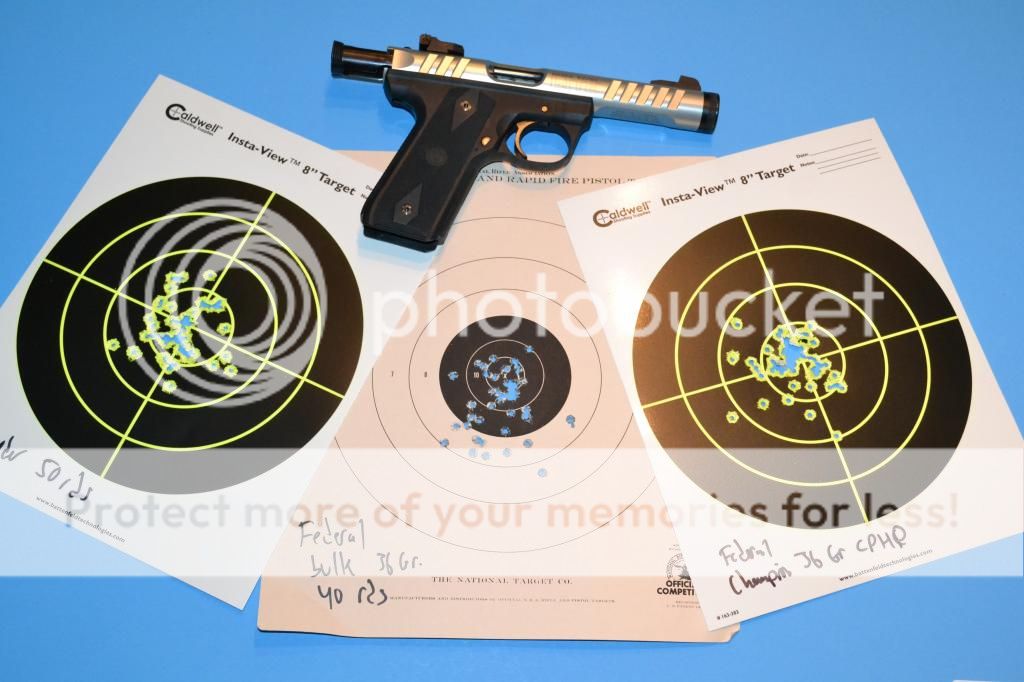
This, really, is where the 22/45 Lite shines. At the heart of it, it's a Ruger Mark [X] - you know it's going to shoot well. I've taken it out close to a dozen times, put well over a thousand rounds of mostly bulk .22LR through it, and pretty much all of the targets look like these:
One bulk, one mid-range, and one higher end rimfire target. There's not a lot of difference in those three targets; granted, a more skilled shooter would almost certainly be able to tighten up those groupings and might even be able to tell the difference in ammo grades. In the case of the left-most target (the aforementioned PMC Sidewinders), the first few rounds out of each magazine (each target had at least 4 magazines run through it) were fired more or less as a single shot. All were shot at 25 feet in a dimly lit indoor range, all were shot freehand in rapid(ish) fire.
At greater distances, the groups open up, but only slightly - the center target saw the first magazine at 50 feet. Any further out and the accuracy is diminished by operator skill (or lack thereof), however it was no difficult task to repeatedly ring an 8" plate at 25 yards. The sights are all black and can get lost on a black target (I prefer orange for the front sight for this reason); however that's mostly just personal preference. Using everything correctly, the 22/45 will put every shot precisely where you want it to go, every single time, with almost boring regularity.
Conclusion.
There's a lot to like, and not much to dislike, with the Ruger 22/45 Lite. While we could live without the magazine disconnect and the side poppin' loaded chamber indicator, pretty much everything else is spot on. The design is excellent (of course it is, it's set after the 1911), the weight is perfect and allows for modifications, and the gun functions exactly like it should all day long. The accuracy is excellent, reliability is very good with one noted exception, and even without a complete takedown (which, the internet tells me, isn't as horrible as some people claim), it keeps running like a top with minimal fuss.
I'm a big fan of the Ruger 22/45 Lite - so much that I decided to keep it!
That is all.
Monday, February 18, 2013
MArooned Product Review: Dragon Leatherworks Belt
Last month I received a leather belt from Dennis at Dragon Leatherworks. He's expanding his line of quality leather products to gunbelts, and sent out a handful of pre-production models to certain gunbloggers for review. Naturally, being a shameless gear whore wanting to help my friend out, I begged asked to help out.
After having worn this belt for literally every day for the past month, I think it's time for a more in-depth review.
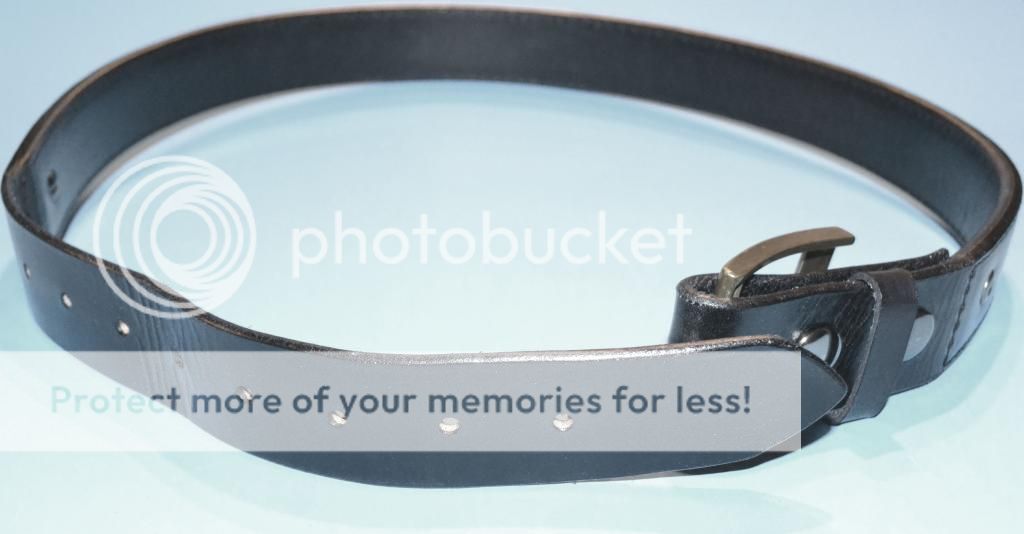
Here's a shot right when I got it:
And here it is after a month of solid wear:
Yeah, not much difference, is there?
After a month of daily use, the notch that I use has a little bit of wear on it. NO cracking, nothing like that, just evidence that this belt has been used in one position over the rest. The entire rest of the belt looks brand new. As a daily wear belt, it's perhaps a bit of overkill - ridiculously overbuilt for merely holding one's pants up - but it does give a good indication of how it will wear over time.
How does it work as a gunbelt, you ask?
Pretty damn good.
That's a two pound, three ounce Smith & Wesson K-frame model 13. With the Dragon Leatherworks gun belt, I can carry it around all day long like it was a 12 ounce Snubbie from Hell™. With a decent cover garment (one advantage to New England winters!) I can carry this around all day long and not even notice the weight. The belt distributes the weight of even a steel-framed revolver very well; I've carried the S&W M&P9 compact as well and it's like nothing's there at all.
I wracked my brain trying to come up with a downside to this belt, and really, the best I could come up with was that it's thick. Yeah, I know. That's not a bug, it's a feature. You have to be deliberate when getting it through belt loops and holster loops. Which, again, is really not a bad thing at all, just that if you're used to traditional belts it takes some getting used to. The belt has held up remarkably over the first month, and I'll revisit how it's holding up sometime late summer/early fall to see if there's any noticeable difference.
Right now, though, two thumbs WAY up for the Dragon Leatherworks gunbelt!
That is all.
After having worn this belt for literally every day for the past month, I think it's time for a more in-depth review.
Here's a shot right when I got it:
And here it is after a month of solid wear:
Yeah, not much difference, is there?
After a month of daily use, the notch that I use has a little bit of wear on it. NO cracking, nothing like that, just evidence that this belt has been used in one position over the rest. The entire rest of the belt looks brand new. As a daily wear belt, it's perhaps a bit of overkill - ridiculously overbuilt for merely holding one's pants up - but it does give a good indication of how it will wear over time.
How does it work as a gunbelt, you ask?
Pretty damn good.
That's a two pound, three ounce Smith & Wesson K-frame model 13. With the Dragon Leatherworks gun belt, I can carry it around all day long like it was a 12 ounce Snubbie from Hell™. With a decent cover garment (one advantage to New England winters!) I can carry this around all day long and not even notice the weight. The belt distributes the weight of even a steel-framed revolver very well; I've carried the S&W M&P9 compact as well and it's like nothing's there at all.
I wracked my brain trying to come up with a downside to this belt, and really, the best I could come up with was that it's thick. Yeah, I know. That's not a bug, it's a feature. You have to be deliberate when getting it through belt loops and holster loops. Which, again, is really not a bad thing at all, just that if you're used to traditional belts it takes some getting used to. The belt has held up remarkably over the first month, and I'll revisit how it's holding up sometime late summer/early fall to see if there's any noticeable difference.
Right now, though, two thumbs WAY up for the Dragon Leatherworks gunbelt!
That is all.
Tuesday, December 11, 2012
MArooned Product Review: MG Arms K-Yote, Part 1
At the NRA convention in April, Ambulance Driver and I stopped by the MG Arms booth to ogle their custom rifles. They have a line of ultra-light bolt action rifles that AD found particularly drool-worthy, whereas I was drawn to the K-Yote line, as I've always taken offense to the notion that the AR-15 platform is not a hunting platform.
After the convention, I heard from Jean at MG Arms. They were interested in sending me a rifle to try out; did I have any hunting planned? As it turns out, I'd started thinking about going to Colorado in the fall to try my hand at varminting, having heard tales of derring-do from last year from my roving reporter SCI-FI. I'd started to make plans to head to CO regardless, and when given the chance to take one of MG Arm's fine hunting rifles with me, well, Mom G. didn't raise any dummies.
A few weeks before leaving for Colorado, a K-Yote arrived at my local fun store:
The Harris bipod is mine, otherwise that's how I took it out of the box. It has a 24" fluted, match-grade free-floating barrel, a JARD target trigger set at 2.5 pounds (yes, 2.5. Do not flip the safety off until you are ready to shoot!), and a Magpul PRS stock. A 6-20X Leupold VX3 scope sits atop the flattop upper, and compliments the rifle perfectly. Even long distance shots were easy with the fine glass and excellent rifle.
MG Arms boasts sub-MOA accuracy, and I'd believe it. Even the most cursory of range outings with me as the loose nut behind the trigger saw 1 MOA or better groups over a wide variety of ammunition ranging from FMJ plinking rounds to high-end handloads (both from MG Arms as well as Wally himself).
But this review is about how the K-Yote did out in the field. I'll write up the bench shooting in a later review when I have more time to review my notes. This time, it's all about reducing the native prairie dog population. Now, I'll pause the review for a second to head off any PETA concerns. Read SCI-FI's report here, particularly this part:
We started off in a gated pasture, parking the truck and walking in. After only a few minutes I really regretted leaving the sling back at the car - totally my fault, mind you. The K-Yote is meant to be slung; I, like an idiot, figured I could carry it - it's certainly lighter than my Savage, right? Lesson learned. While it is indeed light and handy, it's not that light. Weerdbeard dropped a couple with the bolt-action Tikka .223, shooting over the roof of the Toyota to make the first kill. The hunt was on.
We settled in on a section of fence and glassed a nearby ( < 600 yards) prairie dog town. We could see plenty of motion out by the ridge, but even the .223 Remington wasn't going to make those shots with enough reliability to take the chance on missing and going over the berm. We waited, patiently, and were rewarded by renewed activity in the prairie dog world (they are *dumb* as well as vermin).
Resting the K-Yote on top of a fence post, I found a prairie dog town with a great deal of activity about 300 yards out. Aiming at moving targets has absolutely no similarity to a paper target, and I quickly came to understand the whole "hunting thing" - it is absolutely addicting. Tracking, following, deciding; your decisions must be quick, accurate, and immediate. I missed numerous dogs waiting for the perfect shot; in the field, the perfect truly is the enemy of the good.
And then the first hit!
Until this trip, I had only taken potshots at squirrels at SCI-FI and B's cabin in Maine, hardly anything that could be considered hunting. The culmination of a fine rifle, an exquisite trigger pull just right for the best shot, a lazy, fat prairie dog, and a light touch leads to my first downed dog. The hawk that settled in a few minutes later to enjoy the spoils of my shooting confirmed the kill - we had no desire to walk a good quarter mile to the end of the fence and then back.
We piled into the truck and moved to a different section of pasture. This one had a handy berm where we could set up and wait, and I grabbed Ambulance Driver's emergency medical kit as an improvised rest. We started out with a clear section of grass where the prairie dogs were scurrying around, and Ambulance Driver nailed one clean in the noggin at about 150 yards - that boy is a deadeye.
The K-Yote simply excels at prone, rested shooting. I didn't realize it, but I was wandering further and further out at an area that no one else was targeting. I scored several direct hits, but realized something as we walked the area after the shooting was done: a wounded prairie dog goes to ground when hit. They dive right back into their holes. I did manage to come across some proof of hits:
Insides on the outside and blood in the hole. That is a soon-to-be ex-prairie dog. I turned from this hole and ranged the distance to the berm where we were shooting (using the most excellent Leupold RX-800i laser rangefinder, natch!) - 381 yards. I made a killing shot on a creature the size of a football from nearly four football fields away. Two months later that still floors me... It is absolutely to the credit of the K-Yote that I was able to confidently take - and make - a nearly 400 yard shot.
What would I have done differently if I could do it again? There are several things. First off, I would have remembered the damn sling. That alone would have made a big difference. Again, this is in no way, shape, or form a knock at the K-Yote. For it's size it's remarkably light and easy to maneuver; however it's still a full-sized rifle with a 24" heavy barrel. It's heavy, and it gets noticeably more heavy the longer you carry it.
Secondly, the bipod. Shooting in the fenced in area the bipod wouldn't have made much of a difference, but on the plains it would have really be nice to have the sturdy rest. More ammo. Holy smokes, I never realized how much ammo I'd burn through while varmint hunting. I went through close to 50 rounds, and figured I wouldn't need even a fifth of that initially. Next time there will be four loaded 20 round magazines.
And lastly, I have to remember that, even behind the trigger of a finely crafted instrument like the K-Yote, shots will be missed if you hurry them or don't anticipate movement. Waiting an extra second to make certain you are steady to make the shot is fine; waiting ten seconds for the perfect shot, however, is not. I did find that once I got on target, the smooth, light trigger of the K-Yote meant that a prairie dog's lifespan was measured in milliseconds.
My experience with the K-Yote in the field, as limited as it was, was excellent. The rifle is a good weight for carrying - provided you have a sling; the recoil is minimal; the ergonomics excellent. The rifle is just amazingly accurate - despite being shipped out to me from TX, then down to CO, the zero at 200 yards was dead-on. The day before we went out hunting, we stopped at a section of farm to check zero, and it was spot-on at 200 yards. The trigger is crisp, clean, and very light - at 2.5 pounds, it doesn't take much at all. The K-Yote was a simply marvelous choice for varminting:
Look for Part II, which will cover the bench rested shooting, reliability, and ammo selectivity type issues, coming shortly!
That is all.
After the convention, I heard from Jean at MG Arms. They were interested in sending me a rifle to try out; did I have any hunting planned? As it turns out, I'd started thinking about going to Colorado in the fall to try my hand at varminting, having heard tales of derring-do from last year from my roving reporter SCI-FI. I'd started to make plans to head to CO regardless, and when given the chance to take one of MG Arm's fine hunting rifles with me, well, Mom G. didn't raise any dummies.
A few weeks before leaving for Colorado, a K-Yote arrived at my local fun store:
The Harris bipod is mine, otherwise that's how I took it out of the box. It has a 24" fluted, match-grade free-floating barrel, a JARD target trigger set at 2.5 pounds (yes, 2.5. Do not flip the safety off until you are ready to shoot!), and a Magpul PRS stock. A 6-20X Leupold VX3 scope sits atop the flattop upper, and compliments the rifle perfectly. Even long distance shots were easy with the fine glass and excellent rifle.
MG Arms boasts sub-MOA accuracy, and I'd believe it. Even the most cursory of range outings with me as the loose nut behind the trigger saw 1 MOA or better groups over a wide variety of ammunition ranging from FMJ plinking rounds to high-end handloads (both from MG Arms as well as Wally himself).
But this review is about how the K-Yote did out in the field. I'll write up the bench shooting in a later review when I have more time to review my notes. This time, it's all about reducing the native prairie dog population. Now, I'll pause the review for a second to head off any PETA concerns. Read SCI-FI's report here, particularly this part:
It is only by walking these fields that I got to truly appreciate the conditions of Colorado this year: desiccated, dried, scorched, and eaten down to the roots. What the droughts didn't kill, the prairie dogs surely did. This isn't some stereotypical "rednecks hunting harmless critters" event as parodied by Hollywood -- these are pests in extreme overdrive. We get to practice shooting on live targets, but the ones we don't shoot will be eradicated by other means. It truly is "Us versus Them." A farmer gets a 6% return on his investment at best; the more of his crop and cattle he can bring to market, the better a percentage he can eke out of the land. This isn't a Yuppie making a six-figure salary on Wall Street, nor a smelly hippy protesting Wall Street while living off Mommy and Daddy. This is where the rubber meets the road... and where our food comes from.He's not kidding, either. As we walked the field, Ambulance Driver pointed out the various prairie dog towns. Some abandoned, with poison having killed off the majority of the p-dogs; some simply deep underground. The holes made render the grazing fields literally uninhabitable for the cows - the deep holes mean a broken leg or worse, so this becomes unusable land right quick. The prairie dogs that we don't shoot will be poisoned, meaning they pose a threat to predators in offering tainted meat.
We started off in a gated pasture, parking the truck and walking in. After only a few minutes I really regretted leaving the sling back at the car - totally my fault, mind you. The K-Yote is meant to be slung; I, like an idiot, figured I could carry it - it's certainly lighter than my Savage, right? Lesson learned. While it is indeed light and handy, it's not that light. Weerdbeard dropped a couple with the bolt-action Tikka .223, shooting over the roof of the Toyota to make the first kill. The hunt was on.
We settled in on a section of fence and glassed a nearby ( < 600 yards) prairie dog town. We could see plenty of motion out by the ridge, but even the .223 Remington wasn't going to make those shots with enough reliability to take the chance on missing and going over the berm. We waited, patiently, and were rewarded by renewed activity in the prairie dog world (they are *dumb* as well as vermin).
Resting the K-Yote on top of a fence post, I found a prairie dog town with a great deal of activity about 300 yards out. Aiming at moving targets has absolutely no similarity to a paper target, and I quickly came to understand the whole "hunting thing" - it is absolutely addicting. Tracking, following, deciding; your decisions must be quick, accurate, and immediate. I missed numerous dogs waiting for the perfect shot; in the field, the perfect truly is the enemy of the good.
And then the first hit!
Until this trip, I had only taken potshots at squirrels at SCI-FI and B's cabin in Maine, hardly anything that could be considered hunting. The culmination of a fine rifle, an exquisite trigger pull just right for the best shot, a lazy, fat prairie dog, and a light touch leads to my first downed dog. The hawk that settled in a few minutes later to enjoy the spoils of my shooting confirmed the kill - we had no desire to walk a good quarter mile to the end of the fence and then back.
We piled into the truck and moved to a different section of pasture. This one had a handy berm where we could set up and wait, and I grabbed Ambulance Driver's emergency medical kit as an improvised rest. We started out with a clear section of grass where the prairie dogs were scurrying around, and Ambulance Driver nailed one clean in the noggin at about 150 yards - that boy is a deadeye.
The K-Yote simply excels at prone, rested shooting. I didn't realize it, but I was wandering further and further out at an area that no one else was targeting. I scored several direct hits, but realized something as we walked the area after the shooting was done: a wounded prairie dog goes to ground when hit. They dive right back into their holes. I did manage to come across some proof of hits:
Insides on the outside and blood in the hole. That is a soon-to-be ex-prairie dog. I turned from this hole and ranged the distance to the berm where we were shooting (using the most excellent Leupold RX-800i laser rangefinder, natch!) - 381 yards. I made a killing shot on a creature the size of a football from nearly four football fields away. Two months later that still floors me... It is absolutely to the credit of the K-Yote that I was able to confidently take - and make - a nearly 400 yard shot.
What would I have done differently if I could do it again? There are several things. First off, I would have remembered the damn sling. That alone would have made a big difference. Again, this is in no way, shape, or form a knock at the K-Yote. For it's size it's remarkably light and easy to maneuver; however it's still a full-sized rifle with a 24" heavy barrel. It's heavy, and it gets noticeably more heavy the longer you carry it.
Secondly, the bipod. Shooting in the fenced in area the bipod wouldn't have made much of a difference, but on the plains it would have really be nice to have the sturdy rest. More ammo. Holy smokes, I never realized how much ammo I'd burn through while varmint hunting. I went through close to 50 rounds, and figured I wouldn't need even a fifth of that initially. Next time there will be four loaded 20 round magazines.
And lastly, I have to remember that, even behind the trigger of a finely crafted instrument like the K-Yote, shots will be missed if you hurry them or don't anticipate movement. Waiting an extra second to make certain you are steady to make the shot is fine; waiting ten seconds for the perfect shot, however, is not. I did find that once I got on target, the smooth, light trigger of the K-Yote meant that a prairie dog's lifespan was measured in milliseconds.
My experience with the K-Yote in the field, as limited as it was, was excellent. The rifle is a good weight for carrying - provided you have a sling; the recoil is minimal; the ergonomics excellent. The rifle is just amazingly accurate - despite being shipped out to me from TX, then down to CO, the zero at 200 yards was dead-on. The day before we went out hunting, we stopped at a section of farm to check zero, and it was spot-on at 200 yards. The trigger is crisp, clean, and very light - at 2.5 pounds, it doesn't take much at all. The K-Yote was a simply marvelous choice for varminting:
Look for Part II, which will cover the bench rested shooting, reliability, and ammo selectivity type issues, coming shortly!
That is all.
Tuesday, December 4, 2012
MArooned Product Review: Smith & Wesson Bodyguard 38
Over the summer, I picked up a Smith & Wesson Bodyguard 38 for testing and evaluation. I picked up the Bodyguard 380 last year and have really come to like the diminutive autochucker, plus I'm an unabashed revolver fan, so it seemed like a natural fit. Plus I've reviewed the Ruger LCR, the first of the polymer pocket revolvers, and Smith's answer to the LCR needed a closer look.
Off the bat I'll admit my biases. I love Smith & Wesson revolvers. I've carried a J-frame off and on for nearly 20 years now, and appreciate the wonderful simplicity of a five-shot wheelgun as a carry piece. I've carried a near-first year model 36 (Dad's back-up gun on the State Police); a well-worn but still quite functional model 38; and, of course, the Snubbie From Hell™, the fire-breathing 12 ounce .357 Magnum that hurts the shooter almost as much as the shootee. And can hit T-bolt from across the firing line...
The Bodyguard 38 represents a subtle yet radical departure for Smith & Wesson, as well as an industry first. It's not the first nor only polymer revolver (obviously the LCR was the first, and Taurus has a number of polymer-framed revolvers out as well); however it is the first polymer wheelgun in the Smith line as well as being the only revolver with an integral laser:
There's another radical departure for Smith & Wesson in the Bodyguard 38: the cylinder release mechanism:
Rather than the tried-and-true push latch on the "left" side of the revolver, the release mechanism is on the back of the frame. S&W claims this is to make the BG38 ambidextrous, however the cylinder still swings out towards the left, making it less-than-perfect for a southpaw. It's a step in the right direction, and beats a poke in the eye with a sharp stick, but this is one of those cases where I find myself turning into the curmudgeon and saying "I liked it better the old way". Plus the plastic latch - while admittedly quite solid and unyielding after many hundreds of rounds - just doesn't feel the same as the metal push latch. Personal bias, to be sure, and it functions just as it is intended.
From a carry aspect, the Bodyguard 38 is indistinguishable from, well, just about any other J-frame out there. The integral Insight laser is left flush with the cylinder so it fits all standard J-frame holsters (this is where I would normally have a shot of the Bodyguard 38 surrounded by J-frame holsters, but, really, it's a J-frame. It fits everything made for the J-frame. I didn't see the necessity of repeating the shot). It's light (14.3 ounces unloaded, 0.7 ounces lighter than the aluminum-framed model 642, but 2.3 ounces heavier than the Snubbie from Hell™) and fits in a pocket; it'll ride on a belt all day long without causing one's pants to sag; and the hammerless design makes it simple to draw from a pocket or other unconventional holster.
I wasn't a big fan of the Insight laser on the Bodyguard 38. It was difficult to activate with my dominant hand; in fact, the positioning of the unit and activation switch made for awkward contortions to turn the laser on with one hand. Using the support hand was easier, but requires both hands working in concert, a feat easily accomplished at the range but not necessarily under real life conditions. What I did find, though, was that it worked rather well in my left hand - only a minimum of motion was required to turn on the laser when held in my left hand:
So, for a southpaw, the laser works pretty well. There's a minimum of reach and effort to turn the laser on with the left thumb, so activation is significantly easier in the left hand than in the right. It's still not as simple as the Crimson Trace Laser Sight grips, where the grip itself activates the laser so that no additional motion or movement is required, but it's a simple motion that, with practice, is simple to master and add to muscle memory.
As for shooting the Bodyguard 38, again, it's a J-frame. While there are folks that can shoot a double-action only snub-nosed revolver well, the vast majority will require a not-inconsequential amount of range time to gain proficiency. The Bodyguard 38 has a an excellent trigger in its favor, and was easier to shoot double action than a standard SA/DA exposed hammer J-frame. The laser helped as well:
That's a standard reduced silhouette target at 25 feet; the outside rounds were fired rapid-fire without the laser, the ones closest to the inside box were fired rapid-fire with the laser. It really does help get back on target, and out-of-the-box it was sighted in perfectly (Side note: Don't take it apart unless and until you really need to. Just... Don't. Trust me on this). It is more than capable of delivering center-of-mass hits even without the laser at across-the-room expanses; obviously at "bad breath" distances it's even easier.
Conclusion:
If you're a fan of the snubnosed revolver, the Smith & Wesson Bodyguard 38 is definitely something to consider. It's lightweight, simple to clean, and can get solid hits on target in a significant caliber. There's a wide variety of holsters and gear available for the J-frame revolver, so finding the right carry package is simpler than for less-popular arms. While the laser activation may take a little contortion, there's nothing saying you have to use it - and if you want to, you can make it work. It's great for a lefty, and makes a fine back-up (or primary!) for a righty too.
Smith & Wesson Bodyguard 38: It may be partly plastic, but it's all J-frame.
That is all.
Off the bat I'll admit my biases. I love Smith & Wesson revolvers. I've carried a J-frame off and on for nearly 20 years now, and appreciate the wonderful simplicity of a five-shot wheelgun as a carry piece. I've carried a near-first year model 36 (Dad's back-up gun on the State Police); a well-worn but still quite functional model 38; and, of course, the Snubbie From Hell™, the fire-breathing 12 ounce .357 Magnum that hurts the shooter almost as much as the shootee. And can hit T-bolt from across the firing line...
The Bodyguard 38 represents a subtle yet radical departure for Smith & Wesson, as well as an industry first. It's not the first nor only polymer revolver (obviously the LCR was the first, and Taurus has a number of polymer-framed revolvers out as well); however it is the first polymer wheelgun in the Smith line as well as being the only revolver with an integral laser:
There's another radical departure for Smith & Wesson in the Bodyguard 38: the cylinder release mechanism:
Rather than the tried-and-true push latch on the "left" side of the revolver, the release mechanism is on the back of the frame. S&W claims this is to make the BG38 ambidextrous, however the cylinder still swings out towards the left, making it less-than-perfect for a southpaw. It's a step in the right direction, and beats a poke in the eye with a sharp stick, but this is one of those cases where I find myself turning into the curmudgeon and saying "I liked it better the old way". Plus the plastic latch - while admittedly quite solid and unyielding after many hundreds of rounds - just doesn't feel the same as the metal push latch. Personal bias, to be sure, and it functions just as it is intended.
From a carry aspect, the Bodyguard 38 is indistinguishable from, well, just about any other J-frame out there. The integral Insight laser is left flush with the cylinder so it fits all standard J-frame holsters (this is where I would normally have a shot of the Bodyguard 38 surrounded by J-frame holsters, but, really, it's a J-frame. It fits everything made for the J-frame. I didn't see the necessity of repeating the shot). It's light (14.3 ounces unloaded, 0.7 ounces lighter than the aluminum-framed model 642, but 2.3 ounces heavier than the Snubbie from Hell™) and fits in a pocket; it'll ride on a belt all day long without causing one's pants to sag; and the hammerless design makes it simple to draw from a pocket or other unconventional holster.
I wasn't a big fan of the Insight laser on the Bodyguard 38. It was difficult to activate with my dominant hand; in fact, the positioning of the unit and activation switch made for awkward contortions to turn the laser on with one hand. Using the support hand was easier, but requires both hands working in concert, a feat easily accomplished at the range but not necessarily under real life conditions. What I did find, though, was that it worked rather well in my left hand - only a minimum of motion was required to turn on the laser when held in my left hand:
So, for a southpaw, the laser works pretty well. There's a minimum of reach and effort to turn the laser on with the left thumb, so activation is significantly easier in the left hand than in the right. It's still not as simple as the Crimson Trace Laser Sight grips, where the grip itself activates the laser so that no additional motion or movement is required, but it's a simple motion that, with practice, is simple to master and add to muscle memory.
As for shooting the Bodyguard 38, again, it's a J-frame. While there are folks that can shoot a double-action only snub-nosed revolver well, the vast majority will require a not-inconsequential amount of range time to gain proficiency. The Bodyguard 38 has a an excellent trigger in its favor, and was easier to shoot double action than a standard SA/DA exposed hammer J-frame. The laser helped as well:
That's a standard reduced silhouette target at 25 feet; the outside rounds were fired rapid-fire without the laser, the ones closest to the inside box were fired rapid-fire with the laser. It really does help get back on target, and out-of-the-box it was sighted in perfectly (Side note: Don't take it apart unless and until you really need to. Just... Don't. Trust me on this). It is more than capable of delivering center-of-mass hits even without the laser at across-the-room expanses; obviously at "bad breath" distances it's even easier.
Conclusion:
If you're a fan of the snubnosed revolver, the Smith & Wesson Bodyguard 38 is definitely something to consider. It's lightweight, simple to clean, and can get solid hits on target in a significant caliber. There's a wide variety of holsters and gear available for the J-frame revolver, so finding the right carry package is simpler than for less-popular arms. While the laser activation may take a little contortion, there's nothing saying you have to use it - and if you want to, you can make it work. It's great for a lefty, and makes a fine back-up (or primary!) for a righty too.
Smith & Wesson Bodyguard 38: It may be partly plastic, but it's all J-frame.
That is all.
Monday, November 26, 2012
MArooned Guest Review: Kershaw Skyline Fixed-Blade
A guest-post reviewing a fixed-blade from Kershaw from VC correspondent Roadkill. Enjoy!
That is all.
A few years ago, before I really got the knife bug, I picked up a Kershaw Skyline folding knife up at Walmart.(http://www.amazon.com/Kershaw-Skyline-Knife-Textured-Handle/dp/B001CZBDF8) It was good knife and became my EDC blade for the better part of a year. When I discovered that Kershaw had made a fixed blade version, I had to snap one up.
The steel used is Sandvik 14C28 stainless. This is a Swedish steel that I found preformed well in the original Skyline. It can be sharpened to shaving sharpness, maintains its edge well, resharpens wells, and has a solid corrosion resistance. It comparable to the common mid-range knife steels like 440C or AUS8A if not better. Like most stainless steels the strength is good within reasonable usage. Translation: It is steel for a knife not a sharp prybar. This type of stainless is not meant for batoning or chipping through concrete. Be mindful of that and it will last a very long time.The 3.25 inch blade is known as a modified spear-point. A classic spear-point is a drop point where both sides curve at the same angle to meet in the center of the blade. The point position actually improves accuracy in the point. Classic spear-points are often double edged or at least have a false edge on the spine. The center of the blade is where the belly begins for both sides. Unless the blade is very thin or very broad, the shallow belly reduces cutting ability. In a modified spear point the curves at still at the same angle, but the grind starts above the center line and gives the blade a deep belly and greatly improved cutting and slicing ability.
The cutting ability of the Skyline does not disappoint. In this it is much like the original. The deadly sharp blade functioned well in normal EDC tasks. It cut tape, cardboard, paper, and plastics easily. In the kitchen, this little fixed blade really shone. I hold that if a potential defensive knife can’t make the grade there, it won’t work well for emergency goblin cleaving. The knife spent several days making dinner. Medium sized onions and even stocks of green onion proved to be no problem. Despite the short blade length, the Skyline worked surprisingly well against the highly dense sweet potato and ordinary russet potato. I even cut up a head of lettuce into fourths and neatly shredded part for chicken tacos. In cutting meat, it zipped through both raw sirloin and turkey cutlets with a frightening ease. Do not doubt that it can’t do the same to a living thing.
The grip of the Skyline shares the same shape and materials as the folding version. The grips are G-10 and have a good roughness to them and stay grippy even when wet or slimy. I do think they could stand to be flush with the knife tang, but I can’t say that it is necessary. A nice choil provides an excellent purchase. Good choils are a personal preference for me on a defensive blade. In well made sheaths they aid in drawing and during use they keep the knife in your hand. The useless thumbstuds, the sub-par pocket clip, and the lack of jimping kept the folding Skyline from standing next to the Benchmade Griptilian and Spyderco Delica as one of the world’s best EDC knives. Being a fixed blade knife, the newer Skyline automatically looses two of those minor faults. However, the lack of jimping remains. As much as I’d prefer to have the jimping it never really becomes a problem. It is still nicely controllable and easy to use with out them.The first rule of EDC fixed blade knives is to expect to have to buy a custom or third market sheath. As a result I rarely consider a predictably crummy factory sheath to be that much of detraction. However, the Skyline’s simple right handed leather sheath goes beyond crummy and treads upon dangerous. The deep pocket design catches the knife’s guard. The effort to remove the knife could easily cause you to cut yourself or someone else. To illustrate, I was able to suspend an unloaded 3 inch Ruger GP-100 from the knife’s lanyard hole without any danger of it pulling the blade free. Given the tactical feel of the original, I believe that this design would be better served by ambidextrous Kydex sheath that leaves the choil exposed to aid the draw.
In spite of the sheath, the fixed Skyline is an excellent and inexpensive EDC fixed blade. I have no complaints about this excellent knife’s performance. It does everything that EDC or defensive knife should do. Yet, I cannot consider this another job well done by Kershaw. Not when they’ve done everything they can to make this knife die unknown and unloved.
The folding version of the Skyline ended up with respectable following. Searching for “Skyline Knife” on Youtube alone will turn up many reviews. The original was sold by Walmart and various other big box stores in addition to online smaller on and offline stores. The public was well exposed to the folder and sales have kept it in production for years now. A fixed version could expected to capitalize on this popularity. However, new fixed Skyline isn’t new at all. It has been out for a few years already and recently was discontinued. As a Cabela exclusive, this knife has not received any attention save a few mentions on old knife forum posts. No professional reviews, no advertisements, and even Kershaw’s own website contains trace of the fixed Skyline. I would still not know about the fixed Skyline if not for BladeHQ having bought a bunch of them at closeout prices. It is an ignoble end for a very good knife. Visit Cabelas and BladeHQ to snag one of these before they’re gone for good. The Skyline is on BladeHQ’s Black Friday/ Cyber Monday sale for a mere $18.99 in both black G-10 version. They may be all gone before this post is made. (http://www.bladehq.com/item--Kershaw-Skyline-Knife-Black-Fixed--14126)
Special thanks to the early hominids that figured out that sharp rocks were useful and to JayG for abusing his readers with this review.-Roadkill
Thanks for the review, Roadkill!
That is all.
Wednesday, November 14, 2012
MArooned Product Review: Rimfire Designs 1911 Grips
A while back, Mark from Rimfire Designs contacted me about trying out a pair of 1911 grips for review. He was also kind enough to donate a set for my Kilted to Kick Cancer campaign, as well as our most recent fundraiser. In all the excitement, between the KTKC campaign and other recent events, I had pushed the grips onto the back burner, and finally got around to a full review.
First off, I couldn't resist this shot:
Heh. I went to grab one of the many pistol rugs and that was the first one I got ahold of. I took one look at it, said "oh hell yes, I gotta do this" and used it for the picture...
Here's a closer look:
Those are some pretty flippin' sweet looking grips, aren't they?
What I like about them is that they are a perfect amalgamation of form and function. They are both pleasing to the eye as well as solid in the hand. The wood is rough without feeling gritty; a sturdy purchase without tearing up one's tender mitts. The grain of the wood was sufficient to hold it steady while at the range, and didn't shift around at all while in use.
Good sturdy grips that fit well, look great, and function just as they were intended. If you're looking for an upgrade for your 1911, this is one set of stocks that doesn't make you choose between good looks or useability. It's even set up for our sinister friends:
Nice deep relief cut for an ambi-safety. Since my one lone 1911 with an ambi-safety now resides with SCI-FI, I couldn't check it out (although I could get together with SCI-FI...), but everything else about Rimfire Design grips has worked just fine, so I see no reason this wouldn't be a good fit, too.
A set of Rimfire Design stocks, a high-end 1911, and a custom leather holster and you'll be the talk of the BBQ, that's for certain!
That is all.
First off, I couldn't resist this shot:
Heh. I went to grab one of the many pistol rugs and that was the first one I got ahold of. I took one look at it, said "oh hell yes, I gotta do this" and used it for the picture...
Here's a closer look:
Those are some pretty flippin' sweet looking grips, aren't they?
What I like about them is that they are a perfect amalgamation of form and function. They are both pleasing to the eye as well as solid in the hand. The wood is rough without feeling gritty; a sturdy purchase without tearing up one's tender mitts. The grain of the wood was sufficient to hold it steady while at the range, and didn't shift around at all while in use.
Good sturdy grips that fit well, look great, and function just as they were intended. If you're looking for an upgrade for your 1911, this is one set of stocks that doesn't make you choose between good looks or useability. It's even set up for our sinister friends:
Nice deep relief cut for an ambi-safety. Since my one lone 1911 with an ambi-safety now resides with SCI-FI, I couldn't check it out (although I could get together with SCI-FI...), but everything else about Rimfire Design grips has worked just fine, so I see no reason this wouldn't be a good fit, too.
A set of Rimfire Design stocks, a high-end 1911, and a custom leather holster and you'll be the talk of the BBQ, that's for certain!
That is all.
Wednesday, October 10, 2012
MArooned Product Review: Leupold RX-800i Rangefinder
A few months ago I received one of the new Leupold RX-800i Compact Digital Rangefinder units for testing. The good folks at Leupold sent it along to try out on the great Prairie Dog Cull of 2012, and I got a chance to put it to work as intended. Here's the unit in question:
It's unfailingly simple to operate: bring the unit to your eye and depress the button on top. A crosshair will appear in the middle of the field of view which you place over the object to be measured. Depress the button again and it will measure the distance to your target using:
For large or small game, especially in the open like prairie dogs, a rangefinder is a handy tool to have in the range bag. It's simple to operate, accurate, and offers 6X magnification - I was using the RX-800i as a rough spotting scope (it helped locate and determine that the giant black prairie dog was, in fact, a clod of dirt. Well, that and a few rounds through it...). I'm glad I had it with me on the shoot, and can certainly recommend it to any varmint hunter - or hunter in general - who needs to accurately calculate distance to target to make the perfect shot.
The Leupold RX-800i Compact Digital Rangefinder gets an enthusiastic endorsement.
That is all.
It's unfailingly simple to operate: bring the unit to your eye and depress the button on top. A crosshair will appear in the middle of the field of view which you place over the object to be measured. Depress the button again and it will measure the distance to your target using:
...a state-of-the-art laser rangefinder capable of measuring the distance of a deer-sized animal from 6 yards to 550 yards, and a reflective target from 6 yards to 800 yards. The rangefinders emit a series of invisible, infrared energy pulses that are reflected off the selected target back to the optical unit. State-of-the-art circuitry and precision computing circuits are used to calculate the distance by measuring the time it takes for each pulse to travel from the RX-800i to the object and back.Folks, I gotta tell you, whatever electronic voodoo it uses, it freakin' works. The K-Yote is sighted in at 200 yards, and when I ranged a p-dog in the 200 yard range, it had a lifespan measured in milliseconds. Ambulance Driver had a ballistic calculator and was calculating holdovers for me based on the distance to the target as computed by the rangefinder. Using that information - and the supremely accurate MG Arms K-Yote - I was able to take down a prairie dog at nearly 400 yards.
For large or small game, especially in the open like prairie dogs, a rangefinder is a handy tool to have in the range bag. It's simple to operate, accurate, and offers 6X magnification - I was using the RX-800i as a rough spotting scope (it helped locate and determine that the giant black prairie dog was, in fact, a clod of dirt. Well, that and a few rounds through it...). I'm glad I had it with me on the shoot, and can certainly recommend it to any varmint hunter - or hunter in general - who needs to accurately calculate distance to target to make the perfect shot.
The Leupold RX-800i Compact Digital Rangefinder gets an enthusiastic endorsement.
That is all.
Monday, October 1, 2012
MArooned Product Review: Ruger 10/22 Takedown
Ruger caused quite a bit of a stir with the introduction of the 10/22 Takedown at the 141st Annual Meeting of the National Rifle Association in St. Louis, MO earlier this year. Since the 10/22 is, in fact, a long arm and also not in an "assault weapon" configuration, I was able to get my hands on one within a month of the convention (apparently Ruger knew the 10/22 Takedown was going to be a smash hit and made a pile of them...). I've had it since May, been shooting the ever-lovin' heck out of it, and figured it was time to post a review.
The 10/22 Takedown in its native habitat.
I suspect if you saw nothing other than the ginormous hasp and lock, you'd know I was reviewing a Ruger, but everything you see came with the rifle when I picked it up. There's a standard picatinny rail (it comes drilled and tapped for a rail) if you want to put one on; there's a sling for the pack; there's a lock, and the bag itself which is a very slick design - Not only does it carry the rifle and six 25 round magazines - with room for more - but it even doubles as a rest!
If you saw one of these at the range, you'd probably not give it a second look - it's the standard polymer stock and stainless receiver/barrel combination that Ruger has been selling for years. The 10/22 Carbine with synthetic stock and stainless barrel has the same barrel length as well as overall length, and the two are practically twins. Unless, of course, you saw the Takedown like this:
Honey, I cut the gun in half!
There's a $90 difference in MSRP between the 10/22 carbine and the 10/22 Takedown, which probably translates into ~ $70 or so off the shelf. Is it worth ~ $70 to get the Takedown? Are little green apples green? Trust me on this one - it's worth the extra money to have the functionality of the Takedown. The mechanism for taking it down is hands-down the easiest I've ever seen (and I own a few "takedown" models like the Marlin model 39A and a Winchester 1906 - the Ruger is easier by a wide margin to take apart and put back together).
I shot a couple minutes of video to show just how easy the 10/22 Takedown is to take apart and put back together:
The video's a hair over 2 minutes, and I took it apart and put it back together like three times, and the vast majority of that two minutes is me blah blah blahing... It is incredibly simple to take the 10/22 apart and put it back together.
As for shooting the 10/22 Takedown, well, it's a Ruger 10/22. I've had a 10/22 for a few years that I absolutely love shooting, and this one is indistinguishable from it on the firing line. It's just as accurate as a "regular" 10/22:
That's two magazines at 50 feet, unsupported. The Takedown is every bit as accurate as her solid state brethren, and equally reliable. I put somewhere between 900 and 1000 rounds through it with a handful of stovepipes (all of which occurred when using the Eagle 30-round magazines, curse you MA AWB!). It has never failed to fire, and only jammed once on me - and that could easily be due to the fact that I haven't even thought about cleaning it yet...
I sat down and thought long and hard about what I could possibly say bad about the Ruger 10/22 Takedown, and I honestly could not come up with a single thing. The best I could do was that I would hesitate to put the rail on it, as optics would detract from the portability. Once you start adding a scope/red dot/etc., it makes the rifle less streamlined for carrying while broken down. This is a weak point, I will admit - even with a largish scope on it, it'll still break down small and fit in the case provided.
Conclusion:
The Ruger 10/22 Takedown is everything you would expect in a Ruger 10/22 - rock solid reliable, as accurate as the day is long, and just plain fun to shoot while not breaking the bank (I have only fed it the bulk pack Federal 36 grain copper plated rounds readily available for $20 a brick at WalMart). For a little more money than the non-Takedown version, you get a near-invulnerable rifle that can easily be carried in a backpack - and you can shoot it all day long on the cheapest of ammo.
Now, if only someone would come up with a wood stock for it...
That is all.
The 10/22 Takedown in its native habitat.
I suspect if you saw nothing other than the ginormous hasp and lock, you'd know I was reviewing a Ruger, but everything you see came with the rifle when I picked it up. There's a standard picatinny rail (it comes drilled and tapped for a rail) if you want to put one on; there's a sling for the pack; there's a lock, and the bag itself which is a very slick design - Not only does it carry the rifle and six 25 round magazines - with room for more - but it even doubles as a rest!
If you saw one of these at the range, you'd probably not give it a second look - it's the standard polymer stock and stainless receiver/barrel combination that Ruger has been selling for years. The 10/22 Carbine with synthetic stock and stainless barrel has the same barrel length as well as overall length, and the two are practically twins. Unless, of course, you saw the Takedown like this:
Honey, I cut the gun in half!
There's a $90 difference in MSRP between the 10/22 carbine and the 10/22 Takedown, which probably translates into ~ $70 or so off the shelf. Is it worth ~ $70 to get the Takedown? Are little green apples green? Trust me on this one - it's worth the extra money to have the functionality of the Takedown. The mechanism for taking it down is hands-down the easiest I've ever seen (and I own a few "takedown" models like the Marlin model 39A and a Winchester 1906 - the Ruger is easier by a wide margin to take apart and put back together).
I shot a couple minutes of video to show just how easy the 10/22 Takedown is to take apart and put back together:
The video's a hair over 2 minutes, and I took it apart and put it back together like three times, and the vast majority of that two minutes is me blah blah blahing... It is incredibly simple to take the 10/22 apart and put it back together.
As for shooting the 10/22 Takedown, well, it's a Ruger 10/22. I've had a 10/22 for a few years that I absolutely love shooting, and this one is indistinguishable from it on the firing line. It's just as accurate as a "regular" 10/22:
That's two magazines at 50 feet, unsupported. The Takedown is every bit as accurate as her solid state brethren, and equally reliable. I put somewhere between 900 and 1000 rounds through it with a handful of stovepipes (all of which occurred when using the Eagle 30-round magazines, curse you MA AWB!). It has never failed to fire, and only jammed once on me - and that could easily be due to the fact that I haven't even thought about cleaning it yet...
I sat down and thought long and hard about what I could possibly say bad about the Ruger 10/22 Takedown, and I honestly could not come up with a single thing. The best I could do was that I would hesitate to put the rail on it, as optics would detract from the portability. Once you start adding a scope/red dot/etc., it makes the rifle less streamlined for carrying while broken down. This is a weak point, I will admit - even with a largish scope on it, it'll still break down small and fit in the case provided.
Conclusion:
The Ruger 10/22 Takedown is everything you would expect in a Ruger 10/22 - rock solid reliable, as accurate as the day is long, and just plain fun to shoot while not breaking the bank (I have only fed it the bulk pack Federal 36 grain copper plated rounds readily available for $20 a brick at WalMart). For a little more money than the non-Takedown version, you get a near-invulnerable rifle that can easily be carried in a backpack - and you can shoot it all day long on the cheapest of ammo.
Now, if only someone would come up with a wood stock for it...
That is all.
Wednesday, September 19, 2012
MArooned Product Review: Charter Arms Bulldog
When the good folks at Charter Arms sent me the Undercover that I reviewed a few weeks ago, they also sent along one of their big bore revolvers, the Bulldog:
The Charter Arms Bulldog is a five shot, 2.5" barrel .44 Special revolver. It's got an steel frame, brushed stainless finish, rubber grips, and weighs 21 ounces - about as much as a sub-compact 9mm. Instead of offering 10 - 12 rounds of 9mm, though, it has five rounds of .44 Special, a round that's been around since 1907 - a relative newcomer compared to 45 ACP (1902) or 9mm (1904). And yeah, to get it out of the way, the Bulldog gained notoriety in the 1970s when one was used by the Son of Sam killer to murder his victims.
While pocket .45s have lessened the overall allure of a big bore pocket (kinda) revolver, I've been a fan of the .44 Special round for a long time. I had a Taurus model 431 as the second gun I ever bought, and carried it intermittently for a few years as a winter carry gun. Five rounds of even a moderate .44 Special round are nothing to brush off, and looking down the cavernous barrel - and seeing the silvertips at the ready - is a deterrent factor all its own.
Or so I thought when I bought it, mind you. Over time, the heft (the 431 was larger than the Bulldog and certainly heavier) of the gun and the cost of shooting it (even before ammo prices went through the roof, .44 Special was routinely north of $20 for a box of 50 rounds) had me shelve the big Taurus. After a few years of languishing at the bottom of the gun safe, I sold it to fund other purchases, but always held a special place in my safe for another big bore snubbie.
Enter the Bulldog.
Charter's Bulldog is arguably their most famous (some would say infamous) firearm, and with good reason. There are only a handful of companies that make revolvers any more, and even fewer out of that group make something in .44 Special. Taurus offers a handful of revolvers in .44 Special; neither Smith & Wesson nor Ruger list any. The Bulldog stands alone as an American made .44 Special revolver.
The size of the Bulldog puts it somewhere between a Smith & Wesson J-frame and a K-frame, meaning it's a compact(ish) size a little too large for pocket carry but a decent size for IWB carry. It will fit into holsters designed for the K- or L- frames:
I wouldn't rely on any of these holsters providing a lot of retention, though. While the Bulldog is close in size to the guns after which those holsters are modeled, there is still a slight bit of wiggle - certainly not a knock on either the holsters or the Bulldog, just stressing the importance of matching the holster to the gun. Either Dennis or Michael could certainly craft a custom holster that would fit the Bulldog perfectly.
I carried the Bulldog a few times; it's smaller than the S&W model 242ti which I have carried frequently, so it's a good size for a carry revolver; even more impressive in a big bore as opposed to a six- or seven- shot .38 Special. On a personal level, I'd rather carry the smaller J-frame Snubbie from Hell™ with the 125 grain .357 Magnum screamers, but the Bulldog is a lot easier on the hands to shoot. Which, naturally, leads to a discussion of...
Shooting the Bulldog.
Shooting the Bulldog was a lot more painful than I thought it would be - insofar as finding and paying for .44 Special ammo. It hasn't gotten any cheaper since I divested of the Taurus, and has gotten a great deal more rare. The local gun shop had exactly 40 rounds in inventory when I went to pick the Bulldog up, and hasn't had any in stock since. I was able to scrounge another 150 rounds, so the test firing consisted of nearly 200 rounds only. The only issue noticed in all of the shooting was removing all the spent casings - the ejector is shorter than the cylinder, so if you don't pop it just right they don't all come out. This is very common and has happened with every short-barreled revolver that I own.
Even though the revolver only weighs 21 ounces, recoil is supremely manageable. .44 Special is no slouch in the velocity department - 165 grain Corbon rounds routinely clock upwards of 1100 - 1200 FPS. One thing that I did notice, while firing the Bulldog at my club's indoor range, was that there's an impressive fireball that comes out of that 2½" barrel under lower light conditions. It wasn't blinding or "donut of death" like, but it was something to be aware of. The trigger pull is long in double action and still somewhat long in single action, but is clean and uniform throughout.
Accuracy was surprising, given the short barrel, low weight, and long trigger pull:
This is a representative target shot double action at 25 feet. With the exception of one flier (caused by a nasty flinch on the last of 10 rounds), everything's well within the grey area. Followup shots are easy to make; recoil is noticeable but easy to handle; keeping the gun on target is simple and straightforward. The weight to recoil ratio on the Bulldog is excellent - while it's light enough to carry, it's not so light that shooting it is painful.
Conclusion.
For a big bore, lightweight, small-to-medium frame revolver, it shoots and carries well. The finish is spartan, meaning that it's no BBQ gun - but it's not intended to be such. With an MSRP of $426, it's an inexpensive - but not cheap - alternative to the .38 Specials in relative abundance. I found the Bulldog to be decent to shoot (albeit pricey!), more accurate than I am, and rock-solid reliable. It's got a kick and a muzzle flash, and that's what I like about it.
You could say this is one Bulldog whose bark is almost as impressive as its bite.
That is all.
The Charter Arms Bulldog is a five shot, 2.5" barrel .44 Special revolver. It's got an steel frame, brushed stainless finish, rubber grips, and weighs 21 ounces - about as much as a sub-compact 9mm. Instead of offering 10 - 12 rounds of 9mm, though, it has five rounds of .44 Special, a round that's been around since 1907 - a relative newcomer compared to 45 ACP (1902) or 9mm (1904). And yeah, to get it out of the way, the Bulldog gained notoriety in the 1970s when one was used by the Son of Sam killer to murder his victims.
While pocket .45s have lessened the overall allure of a big bore pocket (kinda) revolver, I've been a fan of the .44 Special round for a long time. I had a Taurus model 431 as the second gun I ever bought, and carried it intermittently for a few years as a winter carry gun. Five rounds of even a moderate .44 Special round are nothing to brush off, and looking down the cavernous barrel - and seeing the silvertips at the ready - is a deterrent factor all its own.
Or so I thought when I bought it, mind you. Over time, the heft (the 431 was larger than the Bulldog and certainly heavier) of the gun and the cost of shooting it (even before ammo prices went through the roof, .44 Special was routinely north of $20 for a box of 50 rounds) had me shelve the big Taurus. After a few years of languishing at the bottom of the gun safe, I sold it to fund other purchases, but always held a special place in my safe for another big bore snubbie.
Enter the Bulldog.
Charter's Bulldog is arguably their most famous (some would say infamous) firearm, and with good reason. There are only a handful of companies that make revolvers any more, and even fewer out of that group make something in .44 Special. Taurus offers a handful of revolvers in .44 Special; neither Smith & Wesson nor Ruger list any. The Bulldog stands alone as an American made .44 Special revolver.
The size of the Bulldog puts it somewhere between a Smith & Wesson J-frame and a K-frame, meaning it's a compact(ish) size a little too large for pocket carry but a decent size for IWB carry. It will fit into holsters designed for the K- or L- frames:
I wouldn't rely on any of these holsters providing a lot of retention, though. While the Bulldog is close in size to the guns after which those holsters are modeled, there is still a slight bit of wiggle - certainly not a knock on either the holsters or the Bulldog, just stressing the importance of matching the holster to the gun. Either Dennis or Michael could certainly craft a custom holster that would fit the Bulldog perfectly.
I carried the Bulldog a few times; it's smaller than the S&W model 242ti which I have carried frequently, so it's a good size for a carry revolver; even more impressive in a big bore as opposed to a six- or seven- shot .38 Special. On a personal level, I'd rather carry the smaller J-frame Snubbie from Hell™ with the 125 grain .357 Magnum screamers, but the Bulldog is a lot easier on the hands to shoot. Which, naturally, leads to a discussion of...
Shooting the Bulldog.
Shooting the Bulldog was a lot more painful than I thought it would be - insofar as finding and paying for .44 Special ammo. It hasn't gotten any cheaper since I divested of the Taurus, and has gotten a great deal more rare. The local gun shop had exactly 40 rounds in inventory when I went to pick the Bulldog up, and hasn't had any in stock since. I was able to scrounge another 150 rounds, so the test firing consisted of nearly 200 rounds only. The only issue noticed in all of the shooting was removing all the spent casings - the ejector is shorter than the cylinder, so if you don't pop it just right they don't all come out. This is very common and has happened with every short-barreled revolver that I own.
Even though the revolver only weighs 21 ounces, recoil is supremely manageable. .44 Special is no slouch in the velocity department - 165 grain Corbon rounds routinely clock upwards of 1100 - 1200 FPS. One thing that I did notice, while firing the Bulldog at my club's indoor range, was that there's an impressive fireball that comes out of that 2½" barrel under lower light conditions. It wasn't blinding or "donut of death" like, but it was something to be aware of. The trigger pull is long in double action and still somewhat long in single action, but is clean and uniform throughout.
Accuracy was surprising, given the short barrel, low weight, and long trigger pull:
This is a representative target shot double action at 25 feet. With the exception of one flier (caused by a nasty flinch on the last of 10 rounds), everything's well within the grey area. Followup shots are easy to make; recoil is noticeable but easy to handle; keeping the gun on target is simple and straightforward. The weight to recoil ratio on the Bulldog is excellent - while it's light enough to carry, it's not so light that shooting it is painful.
Conclusion.
For a big bore, lightweight, small-to-medium frame revolver, it shoots and carries well. The finish is spartan, meaning that it's no BBQ gun - but it's not intended to be such. With an MSRP of $426, it's an inexpensive - but not cheap - alternative to the .38 Specials in relative abundance. I found the Bulldog to be decent to shoot (albeit pricey!), more accurate than I am, and rock-solid reliable. It's got a kick and a muzzle flash, and that's what I like about it.
You could say this is one Bulldog whose bark is almost as impressive as its bite.
That is all.
Subscribe to:
Posts (Atom)