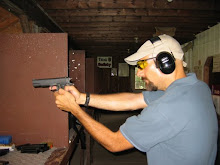
We talked about training on last week's Squirrel Report, in light of some recent training courses that left folks feeling, well, less-than-excited about attending a class. I stand by my assessment of Combat Focus Shooting, though, as a great intro to defensive handgun training.
I wrote an article about my experience getting ready for my very first training class at Shooting Illustrated.
It's centered more on the process of getting ready to take the class - any class, really - and the apprehensions and misgivings that I had going into taking a class of any kind before I actually got there. In a nutshell (although you really should go read the article; I'm especially proud of this one), don't let your fears hold you back - while, yes, you might turn out to be "that guy" after all, you also might not - and you may very well learn something.
Thanks again to the guys at Down Range Firearms Training for putting on an excellent class!
That is all.
Showing posts with label Training. Show all posts
Showing posts with label Training. Show all posts
Monday, June 17, 2013

Thursday, May 23, 2013
Sometimes, You Get To Be The Guy That Has All The Luck...
So, yesterday I get home from a rough day in the salt mines (hey, those pencils don't push themselves!) and I find a large box sitting on the counter for me. Now, there's a few outstanding online orders I'm waiting on, but none of them were expected right now - two were recently placed, and the third is from Brownells, who are absolutely awesome about letting you know when backorders are shipping.
Well, it turned out to be a care package from the good folks at LaserLyte:

Here's where I'd like to say that I played it cool, making key mental notes about how to fit different reviews into my schedule, how to go about securing access to a NAA Black Widow, getting around to talking to Smith & Wesson about getting one of the Shields for T&E, etc. The reality was more that when I opened the box I spent about five minutes going "ohboyohboyohboyohboyohboy"...
I've posted about wanting to try out the Trigger Tyme pistol before - it looks like a great way to safely practice drawing from a holster and firing. It should also be a great teaching aid for a new shooter - they can practice grip, stance, and pulling the trigger without having to be on the firing line. They included the LT-Pro that works with the Trigger Tyme, and a set of the Reaction Tyme targets to test it out on. Very nice training aids indeed - I love the LTS Target and use it frequently.
There's a Training Cartridge in .223 for some AR-15 training, and a sleeve for .308 (and other calibers) for dual-purpose. A Shotgun Trainer and a Tri-Rail round out the longarm goodies, and three additional lasers round out the goodie box: a NAA-Venom and S&W Shield pistol-mounted lasers as well as the picatinny mount Center Mass laser. I am going to be busy busy busy with all these new lasers!
Thanks again to the good folks at LaserLyte for the "care package"!
That is all.
Well, it turned out to be a care package from the good folks at LaserLyte:
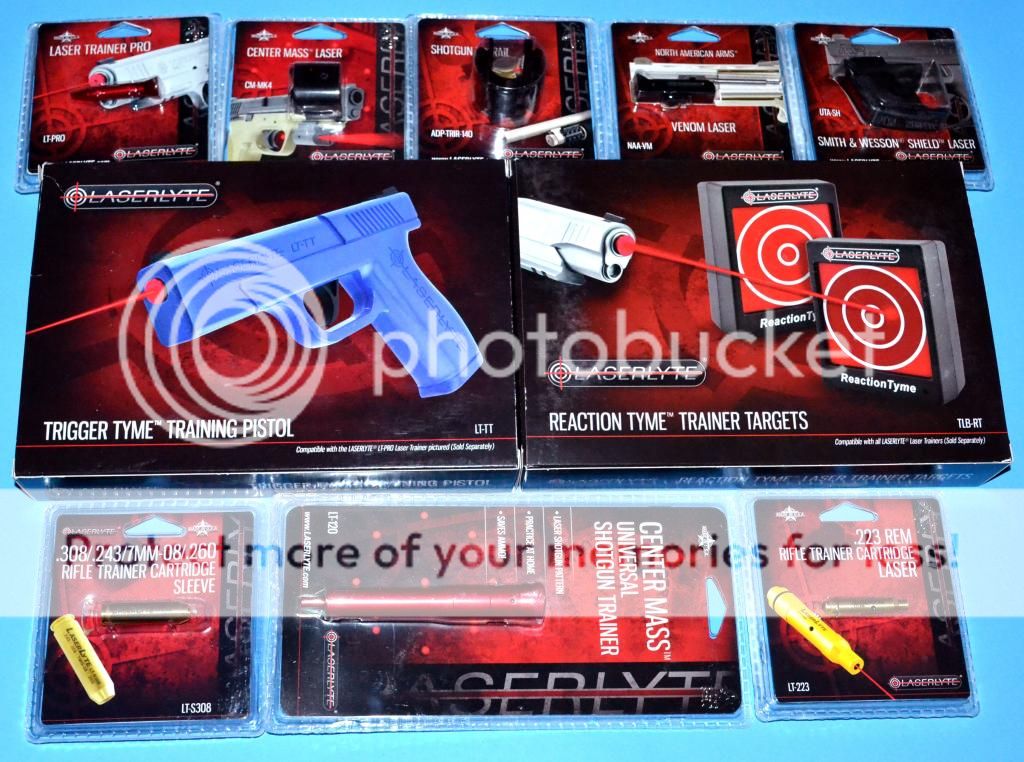
Here's where I'd like to say that I played it cool, making key mental notes about how to fit different reviews into my schedule, how to go about securing access to a NAA Black Widow, getting around to talking to Smith & Wesson about getting one of the Shields for T&E, etc. The reality was more that when I opened the box I spent about five minutes going "ohboyohboyohboyohboyohboy"...
I've posted about wanting to try out the Trigger Tyme pistol before - it looks like a great way to safely practice drawing from a holster and firing. It should also be a great teaching aid for a new shooter - they can practice grip, stance, and pulling the trigger without having to be on the firing line. They included the LT-Pro that works with the Trigger Tyme, and a set of the Reaction Tyme targets to test it out on. Very nice training aids indeed - I love the LTS Target and use it frequently.
There's a Training Cartridge in .223 for some AR-15 training, and a sleeve for .308 (and other calibers) for dual-purpose. A Shotgun Trainer and a Tri-Rail round out the longarm goodies, and three additional lasers round out the goodie box: a NAA-Venom and S&W Shield pistol-mounted lasers as well as the picatinny mount Center Mass laser. I am going to be busy busy busy with all these new lasers!
Thanks again to the good folks at LaserLyte for the "care package"!
That is all.
Friday, March 15, 2013
Open Thread: Gone ... Shootin'?
So, anyone going shooting this weekend? Can you spare the ammo? I find myself limiting my shooting to .22LR and small quantities of .38 Special for my revolvers these days. I have decent stores of .22LR, and .38 Special was, until recently, still available. With the drought continuing on with apparently no end in sight, I can see more and more .22LR shooting in my future.
Anyone else going to the range in spite of dwindling supply?
That is all.
Anyone else going to the range in spite of dwindling supply?
That is all.
Interesting Training Tool
So, I got a presser yesterday about a new training tool available from the folks at LaserLyte. They've come out with their first plastic training handgun, the LT-TT:
 It's a neat concept - a blue gun you can use with the LT-Pro universal laser training device to practice skills like drawing from concealment and firing or engaging multiple threats. Coupled with something like the LTS Target or the Reaction Tyme target and you could have a pretty decent training set-up in the comfort of your living room or man-cave. Heck, even in the family room once the kids go to bed.
One of the great things about a set-up like this is that you could put the targets on a stand in your house where you'd be likely to have a goblin present and train from a variety of points - sitting in the kitchen at the computer; sprawled out on the couch watching TV; you could even set one up in the doorway of your bedroom and practice a scenario for someone coming into your bedroom.
I hope that the LT-TT is the start of a set of training tools; while it's a neat idea on its own, I would really like to see training models made for specific handguns down the road: The Glock 26, the Smith & Wesson M&P, the SIG SAUER P250, etc. If they could get the LT-Pro to sit recessed in the barrel area, perhaps with a positive pressure lock so that it sits flush I think this could be an absolute home run of a training set-up.
It's always great seeing the new items coming out to help us train better, and LaserLyte has a number of great tools. I've got a few of the LTS Training cartridges, and I can't tell you how helpful they are for a variety of tasks like aligning laser sights, training with the LTS Target, or simply practicing in the cold of winter without freezing my fingers off at the range. It's great to see the cool new stuff they're coming out with, and I hope their R&D department keeps churning out new training tools!
Because no matter what - keep training!
That is all.

One of the great things about a set-up like this is that you could put the targets on a stand in your house where you'd be likely to have a goblin present and train from a variety of points - sitting in the kitchen at the computer; sprawled out on the couch watching TV; you could even set one up in the doorway of your bedroom and practice a scenario for someone coming into your bedroom.
I hope that the LT-TT is the start of a set of training tools; while it's a neat idea on its own, I would really like to see training models made for specific handguns down the road: The Glock 26, the Smith & Wesson M&P, the SIG SAUER P250, etc. If they could get the LT-Pro to sit recessed in the barrel area, perhaps with a positive pressure lock so that it sits flush I think this could be an absolute home run of a training set-up.
It's always great seeing the new items coming out to help us train better, and LaserLyte has a number of great tools. I've got a few of the LTS Training cartridges, and I can't tell you how helpful they are for a variety of tasks like aligning laser sights, training with the LTS Target, or simply practicing in the cold of winter without freezing my fingers off at the range. It's great to see the cool new stuff they're coming out with, and I hope their R&D department keeps churning out new training tools!
Because no matter what - keep training!
That is all.
Thursday, March 14, 2013
Ban Assault Staplers!
They're only good for spray-stapling from the hip!
That's Matt from Down Range Firearms Training hamming it up about high capacity assault staplers during the Combat Focus Shooting class last Sunday. This was about the halfway point, when the class was really coming together and we were refreshing targets (and when I took a moment to take off my "shooter taking a class" hat and put on my "press" hat). Firearms politics are bound to come up in a class devoted to teaching shooters, and Matt and I share similar views on the idiocy of the current crop of proposed gun laws (as well as the general idiocy of MA gun laws overall).
The conversation quickly degenerated from there - the stapler was likened to a P90 for the manner in which the staples feed; whether a Calico style feeding system would be superior (no); and Matt's irrational hatred of the 1911 platform (I kid, I kid; he has legitimate reasons as someone who has seen a lot of guns malfunction under the stress of a high-round course. Still doesn't mean I don't want to prove him wrong...). Matt was probably the single biggest factor in getting me to actually take the course - I've known him for years; I know he likes to talk the talk - but I also know that he can certainly walk the walk.
Thanks again for the great day of training, Matt; just be careful of those assault staplers...
That is all.
That's Matt from Down Range Firearms Training hamming it up about high capacity assault staplers during the Combat Focus Shooting class last Sunday. This was about the halfway point, when the class was really coming together and we were refreshing targets (and when I took a moment to take off my "shooter taking a class" hat and put on my "press" hat). Firearms politics are bound to come up in a class devoted to teaching shooters, and Matt and I share similar views on the idiocy of the current crop of proposed gun laws (as well as the general idiocy of MA gun laws overall).
The conversation quickly degenerated from there - the stapler was likened to a P90 for the manner in which the staples feed; whether a Calico style feeding system would be superior (no); and Matt's irrational hatred of the 1911 platform (I kid, I kid; he has legitimate reasons as someone who has seen a lot of guns malfunction under the stress of a high-round course. Still doesn't mean I don't want to prove him wrong...). Matt was probably the single biggest factor in getting me to actually take the course - I've known him for years; I know he likes to talk the talk - but I also know that he can certainly walk the walk.
Thanks again for the great day of training, Matt; just be careful of those assault staplers...
That is all.
Monday, March 11, 2013
Training Review: Fundamentals of Combat Focus Shooting
Yesterday I had the privilege and good fortune to attend the Fundamentals of Combat Focus Shooting course offered by the good folks at Down Range Firearms Training. This was the first organized training course I've attended after being a shooter for nearly 25 years, and it was an eye-opener to say the least. The idea behind CFS is to train for the day we all hope will never come - the day we have to use our firearms in self-defense.
The course itself is very lean - this is a good thing - the basics are taught and practiced; the next skill set is introduced; the basics are reinforced. The stance - a modified Isoceles of sorts - is designed for stability; the upper body is positioned for maximum stability for both the shooter and for the shooting. It's a position that allows for mobility as well as "combat accurate" shooting - a phrase that has earned some well-deserved scorn for overuse, but is spot-on here.
The goal as they phrase it is "The Balance of Speed & Precision" - the shooter should go as fast as they can accurately place rounds on target. While a tight group is desirable for a bullseye shooter, in a defensive scenario it indicates that the shooter should speed up somewhat. The goal is to keep all shots inside the center of the target:

The numbers, well, those are where the precision comes in. The two lower boxes are for multiple aggressor scenarios as well as providing additional target boxes.
Oh, and Matt insisted I take this shot, for some reason:

He said something about people not believing he stapled targets...
Once we worked on the basics - the ready position, the stance, the presentation, etc. - we worked on building speed without sacrificing precision using a combination of different drills, each building on the previous lesson. All of the lessons taught are intuitive, once pointed out, and all make good sense in the context of dealing with a dynamic critical incident.
One of the hardest things for me to get used to - and this is something that is absolutely critical in such an instance - is moving while on the firing line. I commented during the debriefing that I'd been shooting for nearly 25 years now, and this was the first time that I'd shot and moved (Not shooting while moving; that's another course and one I hope to attend in the future). It dawned on me that all of my shooting had been done stationary, with either a bench in front of me or a static firing line.
Getting the movement down - from the "flinch" at the onset of the incident (because, honestly, in real life that's going to happen when you're surprised by a goblin); moving before firing to present a more difficult target to your assailant to moving while reloading - was the hardest part for me to incorporate. I envy the guys that had only recently started shooting - they had nowhere near the decades of institutionalized calcification I had and were able to more seamlessly integrate the concept of motion.
After lunch, with the basics well in-hand, we added more skills like the dynamic reload:
Everything makes sense. Bringing the firearm into the body helps improve stability and make it harder to reach; using both hands in concert facilitates a faster reload; "slingshotting" the slide rather than hitting the slide release is both simpler as well as providing a bit more power to the reload. Simple, intuitive, efficient. The entire course is like this. The hardest part was not looking at the gun while reloading - and this makes absolute sense in a life-or-death situation - you take your eyes off your assailant and you're in grave danger.
Form was critiqued in the "push your limits" drill:
The last set involves hitting the bottom circle as fast as possible. Yes, the distance is very close - approximately 3 yards - but
Towards the end of the day, everything gets pulled together for the "Figure 8" drill. Basically, the targets are set up in close to a 180º arc, and the shooter approaches the line walking a "figure 8" when one of the targets is called out. The shooter is to stop, identify the proper target, present their firearm, and shoot 2-5 rounds to neutralize the threat. Once this is done. the shooter scans the area, holsters, then resumes the figure 8. Here's one in action:
Yeah, it looks kinda funny. It feels like nothing I've ever experienced. Yes, you're still shooting paper targets - but there's that element of the unknown. In that split second that the target is called - and in my case, for example, the target was called as "number of kids you have" - you need to find the right target, present your firearm, line up and take the shot, scan for further threats, and then re-holster. It's a lot to process, and if it wasn't so intuitive it would be a daunting task indeed. Here's a closeup of the targets:

They're all like that. You need to be able to process the information quickly; assume the proper stable stance; present your firearm in a fluid and efficient motion; acquire sight picture; fire - possibly including a reload on the move - and continue scanning for additional threats. Every single shooter ran the figure 8; every single one of us made multiple mistakes in the course of the 3(ish) minute drill.
For the curious, my big mistake was that I neglected to chamber a round when stepping up to the line - despite being given a clear opportunity to do so. It had a full magazine inserted but no round chambered - and the time spent watching others perform the figure 8 drove the fact that I had inserted a loaded magazine without chambering a round right out of my brain. I compounded my error by not running a full tap-rack malfunction set - because I *knew* that it was simply a case of not chambering. Point, though, was that it *could* have been a dud round or another error, and the tap-rack would have fixed that.
I learned a *ton* from this course, folks. If you've only shot at a bench or static shooting line, it is a completely different world. Incorporating motion; a different stance (I'd been a classic Weaver stance shooter for most of my time behind the trigger); balancing speed and precision; bringing it all together was difficult - but the crew from DRFT made it interesting, attainable, and informative. At the end, there were a bunch of tired but happy people:

I can't say enough good things about the excellent training opportunity with Down Range Firearms Training - thanks Ian, Jim, and especially Matt!
That is all.
The course itself is very lean - this is a good thing - the basics are taught and practiced; the next skill set is introduced; the basics are reinforced. The stance - a modified Isoceles of sorts - is designed for stability; the upper body is positioned for maximum stability for both the shooter and for the shooting. It's a position that allows for mobility as well as "combat accurate" shooting - a phrase that has earned some well-deserved scorn for overuse, but is spot-on here.
The goal as they phrase it is "The Balance of Speed & Precision" - the shooter should go as fast as they can accurately place rounds on target. While a tight group is desirable for a bullseye shooter, in a defensive scenario it indicates that the shooter should speed up somewhat. The goal is to keep all shots inside the center of the target:
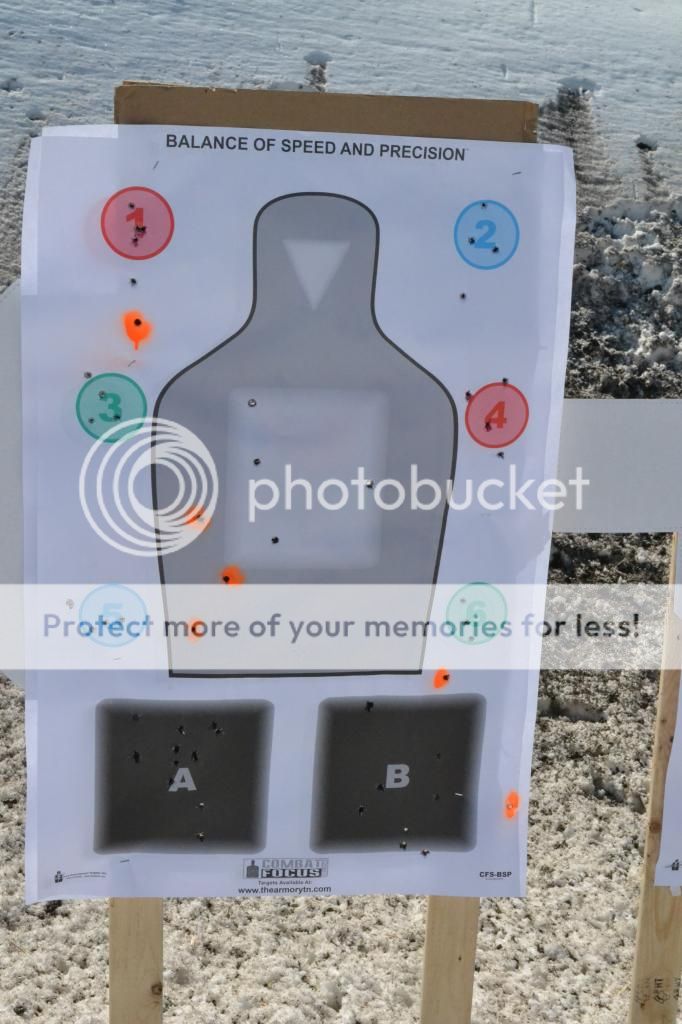
The numbers, well, those are where the precision comes in. The two lower boxes are for multiple aggressor scenarios as well as providing additional target boxes.
Oh, and Matt insisted I take this shot, for some reason:
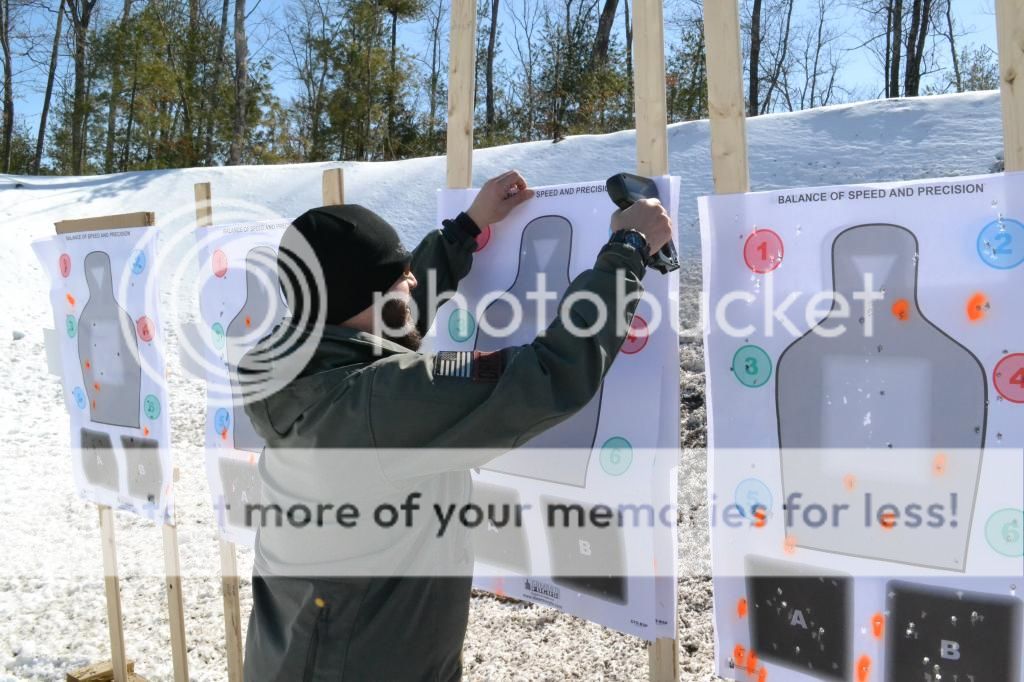
He said something about people not believing he stapled targets...
Once we worked on the basics - the ready position, the stance, the presentation, etc. - we worked on building speed without sacrificing precision using a combination of different drills, each building on the previous lesson. All of the lessons taught are intuitive, once pointed out, and all make good sense in the context of dealing with a dynamic critical incident.
One of the hardest things for me to get used to - and this is something that is absolutely critical in such an instance - is moving while on the firing line. I commented during the debriefing that I'd been shooting for nearly 25 years now, and this was the first time that I'd shot and moved (Not shooting while moving; that's another course and one I hope to attend in the future). It dawned on me that all of my shooting had been done stationary, with either a bench in front of me or a static firing line.
Getting the movement down - from the "flinch" at the onset of the incident (because, honestly, in real life that's going to happen when you're surprised by a goblin); moving before firing to present a more difficult target to your assailant to moving while reloading - was the hardest part for me to incorporate. I envy the guys that had only recently started shooting - they had nowhere near the decades of institutionalized calcification I had and were able to more seamlessly integrate the concept of motion.
After lunch, with the basics well in-hand, we added more skills like the dynamic reload:
Everything makes sense. Bringing the firearm into the body helps improve stability and make it harder to reach; using both hands in concert facilitates a faster reload; "slingshotting" the slide rather than hitting the slide release is both simpler as well as providing a bit more power to the reload. Simple, intuitive, efficient. The entire course is like this. The hardest part was not looking at the gun while reloading - and this makes absolute sense in a life-or-death situation - you take your eyes off your assailant and you're in grave danger.
Form was critiqued in the "push your limits" drill:
The last set involves hitting the bottom circle as fast as possible. Yes, the distance is very close - approximately 3 yards - but
Towards the end of the day, everything gets pulled together for the "Figure 8" drill. Basically, the targets are set up in close to a 180º arc, and the shooter approaches the line walking a "figure 8" when one of the targets is called out. The shooter is to stop, identify the proper target, present their firearm, and shoot 2-5 rounds to neutralize the threat. Once this is done. the shooter scans the area, holsters, then resumes the figure 8. Here's one in action:
Yeah, it looks kinda funny. It feels like nothing I've ever experienced. Yes, you're still shooting paper targets - but there's that element of the unknown. In that split second that the target is called - and in my case, for example, the target was called as "number of kids you have" - you need to find the right target, present your firearm, line up and take the shot, scan for further threats, and then re-holster. It's a lot to process, and if it wasn't so intuitive it would be a daunting task indeed. Here's a closeup of the targets:

They're all like that. You need to be able to process the information quickly; assume the proper stable stance; present your firearm in a fluid and efficient motion; acquire sight picture; fire - possibly including a reload on the move - and continue scanning for additional threats. Every single shooter ran the figure 8; every single one of us made multiple mistakes in the course of the 3(ish) minute drill.
For the curious, my big mistake was that I neglected to chamber a round when stepping up to the line - despite being given a clear opportunity to do so. It had a full magazine inserted but no round chambered - and the time spent watching others perform the figure 8 drove the fact that I had inserted a loaded magazine without chambering a round right out of my brain. I compounded my error by not running a full tap-rack malfunction set - because I *knew* that it was simply a case of not chambering. Point, though, was that it *could* have been a dud round or another error, and the tap-rack would have fixed that.
I learned a *ton* from this course, folks. If you've only shot at a bench or static shooting line, it is a completely different world. Incorporating motion; a different stance (I'd been a classic Weaver stance shooter for most of my time behind the trigger); balancing speed and precision; bringing it all together was difficult - but the crew from DRFT made it interesting, attainable, and informative. At the end, there were a bunch of tired but happy people:

I can't say enough good things about the excellent training opportunity with Down Range Firearms Training - thanks Ian, Jim, and especially Matt!
That is all.
Sunday, March 10, 2013
How I'm Spending My Sunday...
I'm here:

With this guy:

Learning all about how to shoot defensively more efficiently. Taking the Fundamentals of Combat Focus Shooting with Matt DeVito and the crew from Down Range Firearms Training. Learning a lot, don't think I'm embarrassing myself too much, and I'll have a full report later.
Having fun turning money into noise...
That is all.
- Posted using BlogPress from my iPhone

With this guy:

Learning all about how to shoot defensively more efficiently. Taking the Fundamentals of Combat Focus Shooting with Matt DeVito and the crew from Down Range Firearms Training. Learning a lot, don't think I'm embarrassing myself too much, and I'll have a full report later.
Having fun turning money into noise...
That is all.
- Posted using BlogPress from my iPhone
Wednesday, February 27, 2013
First Class...
Literally.
In less than two weeks, I will be taking my first handgun course (well, since my basic firearms safety course in the early 1990s, that is). My buddy Matt at Down Range Firearms Training is running his Fundamentals of Combat Focus Shooting class, and as luck would have it, I've got the weekend free so I will be in attendance. I'll be wearing my "Press" hat as well as being a first-time class attendee, so this should be a world of firsts.
Now, being as how this is my first class - ever - there's quite a bit of second-guessing going on inside the cabeza de Jay G. I'm trying to think what I should bring for a handgun - while I want to bring something that I normally carry, I'm also mindful that shooting a subcompact firearm all day long isn't going to be the most pleasant experience ever. .45 ACP is right out - while I have no problem shooting it all day (and the G30 would be a great choice...), it's just too pricey to go through that much ammo.
So, I'm going to be bringing a 9mm, no question there; the question then becomes whether I run the S&W M&P 9 compact, the Ruger SR9 Compact, or the SIG SAUER P226. I have more magazines for the SIG plus it's an easier gun to shoot; however I've certainly got a better array of carry gear for the M&P. I'm leaning towards the Ruger SR9c, simply because it's easier to shoot than the M&P and it will fit most of the M&P holsters.
I realized something over the weekend - this is a pretty bad time to be trying to gear up. Recommended gear for this course is a kydex holster and a magazine pouch, and I took a quick look online to see what options there were. Right now, there are two choices: Slim and none. Sure, I can grab a nylon one-size-fits-some holster, but after that, everything is out of stock. I can pull something together from existing holsters and such in the big box 'o' holsters, but it was pretty eye-opening to see that even gear is selling like crazy.
I'm looking forward to the class immensely. I've heard very good things about the instruction provided by Down Range Firearms Training as well as having known Matt for years; with any kind of luck this can help to dispel the "minute of berm" bad habits I've picked up over the years. I'm attending the class first and foremost as a new shooter - while I've been shooting for years, this will be the first formal instruction, so I am going to try my best to leave my thoughts on how I think things should be done at home and listen to what is being taught.
We'll see how things work out, but I'm excited and a little nervous about what this class will teach me - mostly about myself.
That is all.
In less than two weeks, I will be taking my first handgun course (well, since my basic firearms safety course in the early 1990s, that is). My buddy Matt at Down Range Firearms Training is running his Fundamentals of Combat Focus Shooting class, and as luck would have it, I've got the weekend free so I will be in attendance. I'll be wearing my "Press" hat as well as being a first-time class attendee, so this should be a world of firsts.
Now, being as how this is my first class - ever - there's quite a bit of second-guessing going on inside the cabeza de Jay G. I'm trying to think what I should bring for a handgun - while I want to bring something that I normally carry, I'm also mindful that shooting a subcompact firearm all day long isn't going to be the most pleasant experience ever. .45 ACP is right out - while I have no problem shooting it all day (and the G30 would be a great choice...), it's just too pricey to go through that much ammo.
So, I'm going to be bringing a 9mm, no question there; the question then becomes whether I run the S&W M&P 9 compact, the Ruger SR9 Compact, or the SIG SAUER P226. I have more magazines for the SIG plus it's an easier gun to shoot; however I've certainly got a better array of carry gear for the M&P. I'm leaning towards the Ruger SR9c, simply because it's easier to shoot than the M&P and it will fit most of the M&P holsters.
I realized something over the weekend - this is a pretty bad time to be trying to gear up. Recommended gear for this course is a kydex holster and a magazine pouch, and I took a quick look online to see what options there were. Right now, there are two choices: Slim and none. Sure, I can grab a nylon one-size-fits-some holster, but after that, everything is out of stock. I can pull something together from existing holsters and such in the big box 'o' holsters, but it was pretty eye-opening to see that even gear is selling like crazy.
I'm looking forward to the class immensely. I've heard very good things about the instruction provided by Down Range Firearms Training as well as having known Matt for years; with any kind of luck this can help to dispel the "minute of berm" bad habits I've picked up over the years. I'm attending the class first and foremost as a new shooter - while I've been shooting for years, this will be the first formal instruction, so I am going to try my best to leave my thoughts on how I think things should be done at home and listen to what is being taught.
We'll see how things work out, but I'm excited and a little nervous about what this class will teach me - mostly about myself.
That is all.
Monday, January 21, 2013
Practice Makes Passable
So, I went to my gun club's indoor range last night. The Mrs. brought the kids to her sister's house for a Patriot's party, and I declined the invite as I'm heading back into work tomorrow for the first time in a week - I'd rather not get home at 11:00 PM, thanks.
I decided to head over to the club with the Ruger 22/45 Lite I've had for T&E, and at the last moment decided to bring along another Ruger, the LCR that I've been carrying a lot lately. The indoor range is lead-ammunition only owing to the simple design of the backstop (steel plate angled at 45º with a sand bed to catch deflected rounds), so in the winter time I find myself shooting mainly .22LR. This time I grabbed a .38 Special revolver and a box of lead wadcutters to give myself a brief refresher on one of my fall-back carry guns.
It took a couple cylinders to warm myself up to the DAO revolver, but once I stopped thinking about it and started shooting, it all came back just fine:

The first cylinder went into the center; the second and third were aimed at the neck area. I put two cylinders through the top section because the first cylinder grouped so well I had to double-check (and hence the two rounds outside the 7-ring...). All shots are well in the black; all were fired rapid-fire and at 25 feet, starting at low-ready. It's amazing how the muscle memory works - once I kicked over from "target shooting" mode from the 22/45 and into "defensive shooting" mode, it was second nature.
I call it "passable" because that's all I was looking for - I wanted to make sure I could still shoot the short-barreled revolver with sufficient proficiency as to maintain it as a viable defensive arm. Being able to keep all shots center-of-mass at a fair distance is exactly what I wanted to do, and it's gratifying to find I can still do it. Granted, the Crimson Trace Lasergrips don't hurt keeping things on target, and I cannot recommend them strongly enough for a defensive handgun.
It's not often that "good enough" actually is, but in this case I'm quite pleased with the end result.
That is all.
I decided to head over to the club with the Ruger 22/45 Lite I've had for T&E, and at the last moment decided to bring along another Ruger, the LCR that I've been carrying a lot lately. The indoor range is lead-ammunition only owing to the simple design of the backstop (steel plate angled at 45º with a sand bed to catch deflected rounds), so in the winter time I find myself shooting mainly .22LR. This time I grabbed a .38 Special revolver and a box of lead wadcutters to give myself a brief refresher on one of my fall-back carry guns.
It took a couple cylinders to warm myself up to the DAO revolver, but once I stopped thinking about it and started shooting, it all came back just fine:

The first cylinder went into the center; the second and third were aimed at the neck area. I put two cylinders through the top section because the first cylinder grouped so well I had to double-check (and hence the two rounds outside the 7-ring...). All shots are well in the black; all were fired rapid-fire and at 25 feet, starting at low-ready. It's amazing how the muscle memory works - once I kicked over from "target shooting" mode from the 22/45 and into "defensive shooting" mode, it was second nature.
I call it "passable" because that's all I was looking for - I wanted to make sure I could still shoot the short-barreled revolver with sufficient proficiency as to maintain it as a viable defensive arm. Being able to keep all shots center-of-mass at a fair distance is exactly what I wanted to do, and it's gratifying to find I can still do it. Granted, the Crimson Trace Lasergrips don't hurt keeping things on target, and I cannot recommend them strongly enough for a defensive handgun.
It's not often that "good enough" actually is, but in this case I'm quite pleased with the end result.
That is all.
Friday, July 6, 2012
Two Wheelin' Pet Peeve...
Events conspired to allow me to ride to work today for the first time this riding season. Having two kids that need to be dropped off at camp means I don't often take the motorcycle, as their camp is about halfway in between home and my office - and I'm not about to drive them to camp, drop them off, then turn around and drive home to grab the bike. Today, however, the Mrs. had the day off for working the July 4th holiday, so I took the Harley to work. It's a great way to start your workday...
It got me thinking, though, about something I've seen a fair amount of lately that's had me gritting my teeth and cringing. It's folks riding motorcycles who, during low speed maneuvers, keep their feet hovering microns off the ground or - even worse - skipping across the pavement. Some of them doing this while wearing sneakers. Every time I see this I picture a broken ankle when they hit a rough patch of road.
It's not quite the same when talking about a 400 pound sport bike as an 800 pound touring bike, of course; I'm certain that some of my apprehension comes from my experience on the Harley. My motorcycle outweighs me more than 4:1 - if it goes down, I'm going to have a hard time getting it back. If it goes down because I folded my leg under me from hitting a broken section of road, I'm in for a world of hurt - and possibly a broken leg to match my ankle.
Here's where I can't stress taking a Motorcycle Safety Foundation course strongly enough. Whether you've been riding for years or just starting out, there's always something to learn - kinda like with shooting, actually. You can hone your skills and possibly learn new ones by taking classes with experts - and then apply these new skills right out on the asphalt (like a pistol course at a range!). If you're not learning, you're getting stale - and whether it's on a motorcycle or carrying a firearm, that's never a good thing.
So, whatever your passion, make sure your skills are up to date!
That is all.
It got me thinking, though, about something I've seen a fair amount of lately that's had me gritting my teeth and cringing. It's folks riding motorcycles who, during low speed maneuvers, keep their feet hovering microns off the ground or - even worse - skipping across the pavement. Some of them doing this while wearing sneakers. Every time I see this I picture a broken ankle when they hit a rough patch of road.
It's not quite the same when talking about a 400 pound sport bike as an 800 pound touring bike, of course; I'm certain that some of my apprehension comes from my experience on the Harley. My motorcycle outweighs me more than 4:1 - if it goes down, I'm going to have a hard time getting it back. If it goes down because I folded my leg under me from hitting a broken section of road, I'm in for a world of hurt - and possibly a broken leg to match my ankle.
Here's where I can't stress taking a Motorcycle Safety Foundation course strongly enough. Whether you've been riding for years or just starting out, there's always something to learn - kinda like with shooting, actually. You can hone your skills and possibly learn new ones by taking classes with experts - and then apply these new skills right out on the asphalt (like a pistol course at a range!). If you're not learning, you're getting stale - and whether it's on a motorcycle or carrying a firearm, that's never a good thing.
So, whatever your passion, make sure your skills are up to date!
That is all.
Tuesday, March 20, 2012
More Cool Stuff...
Fresh on the heels of being awarded the NRA's Golden Bullseye award for their TLB-1 training system, LaserLyte has come out with the perfect complement to the TLB-1 for those who carry a pocket .380:
 The LTS-380 training cartridge. I've reviewed the LTS training cartridges previously, and they're just a fantastic complement to dry-firing or the training target. Lock the slide back, drop a training cartridge in the breech, close the slide, and fire away. Using this in conjunction with TLB-1 just adds so much value to the dry fire experience - you smooth the trigger, improve your skills, and don't even have to leave your living room to do it.
You know what this is *fantastic* for? Drawing from concealment and firing. You have every element needed for a realistic scenario - you can position the target in a number of different places, you can draw, aim, and fire and see if you can score a hit under pretty realistic scenarios. Where you're using it in your own home - with no worries about lead, noise, or unintended holes, you can even practice defensive situations inside the home with your home defense pistol (or carbine, if you have a 9mm, .40S&W, or .45 ACP carbine).
And guys, I've got a P3AT and a Bodyguard 380 that would be perfect for testing one of those units... :)
That is all.
 The LTS-380 training cartridge. I've reviewed the LTS training cartridges previously, and they're just a fantastic complement to dry-firing or the training target. Lock the slide back, drop a training cartridge in the breech, close the slide, and fire away. Using this in conjunction with TLB-1 just adds so much value to the dry fire experience - you smooth the trigger, improve your skills, and don't even have to leave your living room to do it.
You know what this is *fantastic* for? Drawing from concealment and firing. You have every element needed for a realistic scenario - you can position the target in a number of different places, you can draw, aim, and fire and see if you can score a hit under pretty realistic scenarios. Where you're using it in your own home - with no worries about lead, noise, or unintended holes, you can even practice defensive situations inside the home with your home defense pistol (or carbine, if you have a 9mm, .40S&W, or .45 ACP carbine).
And guys, I've got a P3AT and a Bodyguard 380 that would be perfect for testing one of those units... :)
That is all.
Tuesday, March 6, 2012
Grist for the Mill...
Yankeefried sent me a most thought-provoking link:
Self Defense Findings
Self Defense Findings
The following comes to us courtesy of Claude Werner, Director of Firearms Training LLC. It is an analysis of five years of incidents reported in the NRA "Armed Citizen" column.Go take a read; it's fascinating stuff. I want to call out a few things:
- Private citizens reload in approximately 1/2 of one percent of shooting incidents (3/482).
- The shooting distance in the vast majority of cases was slightly in excess of arm's length.
This is something that Matt of Down Range Firearms Training and I were discussing a few weeks back. One of the exercises that he has students go through starts off touching the target, taking one step back, and firing. So often we train at distances pre-set by the range rules or the gun club, and rarely at the "bad breath" distances in which attacks generally occur.
- The firearm was carried on the body of the defender in only 20% of incidents. In 80% of cases, the firearm was obtained from a place of storage, frequently in another room.
This isn't all that surprising when you think about it - the majority of the stories in the Armed Citizen revolve around home invasions. They're easier to defend in the court of public opinion - by simple virtue of being in someone else's home, the goblin has given very good reason for "why" they got ventilated. It's hard to paint a homeowner defending their castle as a Travis Bickle wanna-be.
Training is still very important; that's not the lesson here. Even if all that's needed to end the fight are two shots from a S&W J-frame, being able to do that under the incredible stress of a life-threatening situation is far easier if it has been practiced over and over until it becomes automatic. Push back, draw, fire. Push back, draw, fire. Lather, rinse, repeat. Practice drawing from concealment and firing as much as you can, even if it's using snap caps in your basement.
Mindset is still the most important thing to survival. Folks can either curl into a ball and hope that the bad person goes away, or they can get angry and fight back. When folks fight back, there's a pretty good body of evidence that indicates they will be successful; at least more successful than rolling over and waiting to die. The whole bit about "better an armed rabbit than an unarmed wolf" is very applicable here - but it's best to be an armed wolf...
Very interesting food for thought indeed...
That is all.
Tuesday, February 21, 2012
Trigger Time...
In addition to hitting the range on Saturday with Daniel in Brookline, I went out yesterday with Matt of Down Range Firearms Training. In addition to being a firearms instructor and all-around good guy, Matt works part time at the local fun store, and transferred my S&W M&Ps when they came in for T&E. He mentioned that he had two for DRFT, and that both had trigger jobs, and volunteered if I wanted to try an M&P without the horrid MA trigger to give him a shout.
Wrapping up the T&E period for the M&Ps, I had a chance to head out to the range with Matt, and wanted to give a shout out to say thanks. Matt didn't just bring his two M&Ps:

Wrapping up the T&E period for the M&Ps, I had a chance to head out to the range with Matt, and wanted to give a shout out to say thanks. Matt didn't just bring his two M&Ps:

M&P45

M&P9
M&Ps in 9mm and .45 ACP, same as the two I have been testing (only my M&P9 is the compact version). Both have had trigger work done by Business End Customs, and both are significantly more fun to shoot than the stock MA trigger versions. Experiencing the difference between the two triggers puts the M&P in a completely different light, that's for sure.
Matt had a few surprises for me as well:
Caracal
That's one of the Caracal pistols from the United Arab Emirates. They had a booth at SHOT Show Media day, but I didn't get a chance to try them out. Matt did, and was impressed by the company enough to request a unit to test for his training purposes. The Caracal ran very smoothly - I put well over 100 rounds through it without a single hiccup (well, not counting my failure to fully seat the magazine...) even under rapid fire. The low bore axis allows for rapid shooting while remaining on target easily. It's a well-built pistol that gives the boys from Austria some competition...
And lastly, we had some fun with longarms:

M&P15s
Matt brought a couple of Smith & Wesson M&Ps in rifle form as well as pistols. Top is a M&P15-22, the bottom is a custom M&P15 with custom touches. Both were insanely fun to shoot - the .22LR version especially, as there's no recoil and it's just a ton of fun to ring a steel plate with every round fired as fast as possible. The .223 version is insanely accurate - given what he's put into it, it better be - and if I hadn't been freezing my fingers off I'd have gone through more of Matt's ammo...
Matt was also kind enough to offer some pointers on my shooting form as pertains to fast, accurate shooting. We discussed the Weaver vs. Isosceles stance, and he brought up some very good points about the defensibility of the Isosceles over the Weaver - definitely going to be working on improving things! Even though we don't see eye to eye on the 1911 being the greatest pistol ever made (inside joke), he's got his head on straight and is one helluva instructor.
Thanks again Matt!
That is all.
Wednesday, July 27, 2011
Always Learning...
I got an e-mail the other day from the folks from the Armed Response program about their line of instructional DVDs. They've partnered with Michael Bane from Downrange TV fame and have a series of short instructional tips uploaded on the Downrange TV site. They've also got their own YouTube Channel with a series of short clips on everything from pepper spray usage to tips on cleaning.
And, just to add to the "hey, I know that guy" part, the gentleman who e-mailed me happens to live in MA - and sold me my S&W 242!
That is all.
And, just to add to the "hey, I know that guy" part, the gentleman who e-mailed me happens to live in MA - and sold me my S&W 242!
That is all.
Wednesday, May 11, 2011
Training: Let's Get Some!
I've mentioned before about wanting to get some more training under my belt. After touring the Sig Academy, seeing the facility and getting the chance to talk to some of the instructors there, I'd like to get my start there. I've gone back and forth between their Handgun 102 and 103 classes, trying to decide if the 102 course is too basic, etc. but I think 102 is the place to start.
The last time I asked, we got a few folks interested in taking the Handgun 102 course:
JD
libertyman
yankeefried
PISSED
Butch Cassidy
Keystone
rich
Looking at the calendar, there's a Handgun 102 class in the Epping, NH facility on Sunday, June 5th and Sunday, June 18th. Do either of these dates work for folks? Is everyone still in?
I'm happy to call up Sig Academy and see if we can't get a group training session together; we need to pick a date and make sure we've got the group assembled first, though.
Let me know if you're in and which day you'd prefer, and let's make this definite!
That is all.
The last time I asked, we got a few folks interested in taking the Handgun 102 course:
JD
libertyman
yankeefried
PISSED
Butch Cassidy
Keystone
rich
Looking at the calendar, there's a Handgun 102 class in the Epping, NH facility on Sunday, June 5th and Sunday, June 18th. Do either of these dates work for folks? Is everyone still in?
I'm happy to call up Sig Academy and see if we can't get a group training session together; we need to pick a date and make sure we've got the group assembled first, though.
Let me know if you're in and which day you'd prefer, and let's make this definite!
That is all.
Tuesday, March 8, 2011
Training. Get Some!
Okay, the year's chugging along nicely. Over a month ago, I bandied about the idea of getting some folks together to take a training course at Sig Academy, seeing as how we got a good look at their impressive training facility during our tour there before the Third Annual Northeast Winter Social. We kinda got bogged down in a discussion over whether folks would rather take the Handgun 102 course or the Handgun 103 course, and never really followed up on it.
Mopar made some excellent points about the 102 class - most of us who would be going have covered a good 90% of the course material:
I'd like to take the 102 course. I'm pretty confident that I have the handgun selection, gear, and cleaning down; but I know I could benefit from instruction on my shooting form. I'm not too proud to admit that I might benefit from some guidance on shooting positions, too - everything I've learned has been self-taught, mostly through trial and error along the way. And lastly, I know for certain I could use more time presenting a loaded firearm, and what better place to develop those skills than at a place like Sig Academy?
Who's interested in the Handgun 102 course? If we've got enough folks interested in the more basic course, perhaps we could run two Northeast Blogger training sessions. I still want to take the Handgun 103 course after; possibly later this summer. Unfortunately, the next two months are booked solid - Sundays are out through mid-April (CCD); March and April are Scout-intensive months and April is just booked solid. May opens up a little, perhaps 102 sometime in May and then 103 in August or September?
Let me know who's interested - 102 and/or 103 - and we'll start pulling something together!
That is all.
Mopar made some excellent points about the 102 class - most of us who would be going have covered a good 90% of the course material:
- Handgun Selection Considerations
- Support Equipment
- Shooting Basics - the Importance of Proper Grip, Sight Alignment, Sight Picture, Stance, Trigger Control and Follow Through
- Presentation of the Handgun from the Holster to the Target and Safe Recovery Back to the Holster
- Administrative and In-service Loading and Unloading Techniques
- Static Shooting Positions
- Cleaning and Maintenance
I'd like to take the 102 course. I'm pretty confident that I have the handgun selection, gear, and cleaning down; but I know I could benefit from instruction on my shooting form. I'm not too proud to admit that I might benefit from some guidance on shooting positions, too - everything I've learned has been self-taught, mostly through trial and error along the way. And lastly, I know for certain I could use more time presenting a loaded firearm, and what better place to develop those skills than at a place like Sig Academy?
Who's interested in the Handgun 102 course? If we've got enough folks interested in the more basic course, perhaps we could run two Northeast Blogger training sessions. I still want to take the Handgun 103 course after; possibly later this summer. Unfortunately, the next two months are booked solid - Sundays are out through mid-April (CCD); March and April are Scout-intensive months and April is just booked solid. May opens up a little, perhaps 102 sometime in May and then 103 in August or September?
Let me know who's interested - 102 and/or 103 - and we'll start pulling something together!
That is all.
Monday, January 31, 2011
Similar Vein...
Since I posted about a training course in my last post, I thought I'd get the ball rolling on something I've been kicking around since the beginning of the month. After spending part of the afternoon at Sig Academy, and seeing the magnificent facility they have in lovely Epping NH, I think I would like to take one of their training courses. I'm thinking specifically of the Handgun 102 course - I am fairly confident that I know all the material in their Handgun 101 course, but am not so sure I'm sufficiently advanced for the Handgun 103 course.
Other than my Basic Firearms Safety course that I took 17 years ago before getting my LTC, I've never had any formal training. It's long past time to remedy this significant deficiency in my readiness and preparedness plans, and having seen the facilities and the folks who staff Sig Academy, I'm confident that the training they will provide will be top-notch. Not to mention that Lissa seemed to really get a lot out of the class she took there. Add in that they're only about 45 minutes from me, and I'd use my P226 anyways, and it's a no-brainer to take this class!
So, who's in it with me? Anyone else interested in taking Handgun 102 sometime in the next few months? Sig Academy has classes roughly twice a month (click "Schedule" at the bottom of the Handgun 102 page), so we can pick a date that works for everyone once we have an idea who'd like to come. If there's a compelling reason to start with Handgun 101 - or to skip ahead to Handgun 103 - I'm more than willing to listen to it. I feel comfortable with my general gun-handling skills and knowledge of existing gun laws that the 101 course might be a little too introductory; I'm not so brash to think that my meager ability or "skill" puts me in the intermediate category needed for the 103 course.
Now, the big questions is, if I can get enough folks to sign up, can we get a group discount rate? :)
That is all.
Other than my Basic Firearms Safety course that I took 17 years ago before getting my LTC, I've never had any formal training. It's long past time to remedy this significant deficiency in my readiness and preparedness plans, and having seen the facilities and the folks who staff Sig Academy, I'm confident that the training they will provide will be top-notch. Not to mention that Lissa seemed to really get a lot out of the class she took there. Add in that they're only about 45 minutes from me, and I'd use my P226 anyways, and it's a no-brainer to take this class!
So, who's in it with me? Anyone else interested in taking Handgun 102 sometime in the next few months? Sig Academy has classes roughly twice a month (click "Schedule" at the bottom of the Handgun 102 page), so we can pick a date that works for everyone once we have an idea who'd like to come. If there's a compelling reason to start with Handgun 101 - or to skip ahead to Handgun 103 - I'm more than willing to listen to it. I feel comfortable with my general gun-handling skills and knowledge of existing gun laws that the 101 course might be a little too introductory; I'm not so brash to think that my meager ability or "skill" puts me in the intermediate category needed for the 103 course.
Now, the big questions is, if I can get enough folks to sign up, can we get a group discount rate? :)
That is all.
Unlikely Places...
I got an e-mail late last week about a firearms training course that I thought I'd share:
Besides, I dig their tagline of "Learn from the best. Have fun".
That is all.
My name is [redacted per request], and I have been reading your blog for a while now. I am from [location outside of Massachusetts] and enjoyed shooting rifle back at home. However, when I moved to MA for school, I was suddenly no longer able to do those things... it has been really frustrating, to say the least.Hmmm. A firearms training course started and run by students at Harvard Business School. No, I wouldn't be interested in this in the least... They've got locations all around the country, with different courses ranging from introductory handgun to basic rifle, and are definitely worth looking into if you're interested in a training course. I'm always happy to give a shout-out to local businesses, and it kicks over my giggle box to be promoting a firearms training course out of Harvard...In that vein, I'm writing to let you know about a project: http://www.athena-advantage.com/Veterans and active soldiers at Harvard Business School, who share my frustration with MA, have started a firearms training course for everyone from beginners to skilled sportsmen. You can see the trainers profiles here: http://www.athena-advantage.com/teamI am working hard to get the word out in MA about the opportunity to learn proper, responsible firearms skills and techniques. I thought you and your readership would be very interested. Please don't hesitate to ask any questions you might have!
Besides, I dig their tagline of "Learn from the best. Have fun".
That is all.
Subscribe to:
Posts (Atom)