A few weeks ago, I received a package from
Crimson Trace with some Laser Sight Grips courtesy of Iain Harrison after a chat at the 2011 NRA Annual Meeting. There were three different sets for review:
- Smith & Wesson J-frame revolver
- SIG SAUER P226
- 1911 Officers model
I installed the units immediately - one of the many benefits of the Crimson Trace Laser Sight Grips is that they are exceedingly easy to install. If you can swap out grips, you can install Crimson Trace Laser Sight Grips; it's just that simple. Remove old grips, put batteries in CT unit, put CT grips on firearm. Done. The laser dot is clear and easily resolved at distances up to 25 yards on an outdoor range in sunlight (although the berm is covered); indoor applications or at nighttime the dot is clearly visible at much greater distances (the swingset in my backyard is easily 200 feet from the house, frex).
The CT units do not interfere with how the firearms sit in holsters whatsoever; this is obvious by their design and manner of usage. They're installed on the grip and maintain the same profile as the original design; even on the Smith & Wesson revolver in pocket holsters there was no change in fit or profile. There was no noticeable change in how the firearms were presented from the holster during a draw, again, even with the pocket holster.
Activation of the units is where Crimson Trace excels. The design of the unit is such that one's middle finger covers the activation button, and when gripped firmly while shooting the laser sight is engaged. Once the grip is relaxed, the button is released and the laser sight is disengaged. There is no need for the support hand to be involved or for the trigger finger (or other finger) to activate a switch, lever, or button anywhere else on the firearm. Using the Crimson Trace Laser Sight Grips requires no action other than the standard grip and trigger squeeze.
I've had each of the units out to the range at least twice (Colt), some as many as five times (P226). The S&W J-frame unit needed the most tweaking to achieve proper alignment with where the shots were landing; the 1911 grips were spot-on right out of the box. Sighting in the grips was quite easy (although it took a while - laser sights are not a magical panacea for shooting ills; you still have to hold the gun steady to get the shots where they need to go - obviously no fault of Crimson Trace here).
The Colt is not included in this report as it has only been to the range twice; while it has performed very well so far, I'd still like to shoot it a few more times before passing judgement. The S&W grips have been thrice, the P226 five or six times (hey, it's .22LR, I'm a cheap SOB and I can shoot it on the indoor range at my gun club). I'll review these two now and check the Colt grips later on (although so far from what I've seen the Colt grips are fine).
The last time I brought CT-equipped firearms to the range, it was raining cats and dogs (I was on vacation; naturally, it rains). I availed myself of the indoor range at my club, a cozy (real estate folks know this is code for "tiny") four position, 50 foot lead ammunition-only range under the clubhouse. The backstop is a piece of plate steel angled 45º to the ground, so the club requires lead ammunition only so as not to ding the steel. The jury is out on frangible ammunition, which would open up what I can shoot indoors immeasurably.
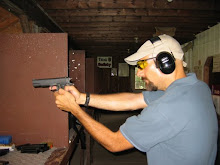
Here's a view of the grips on my P226:

Sorry about the arm hair
The target's at about 25 feet to 10 yards; the dot is crisp and just a bit low and left - but close enough that further adjustments only overshot the center and weren't adding any value to the experience. Laser sights are more often used for defensive purposes, where being off a half-inch really isn't critical to the mission, but rapid follow-up shots are. (Side note: Any idea how hard it is to get a picture of yourself holding a firearm using your weak hand for the camera???)
Once the grips are adjusted, shooting is an absolute dream. Here's the typical aftermath at the 25-30 foot distance:

Not too shabby
Each target has 20 rounds (2 magazines, all I currently own for the .22LR conversion). All are shot rapid fire, offhand; first shot DA, remaining SA. The largest spread is just under 3", the others at 2" and 2½" (approximate).These three targets were representative of all targets shot with the P226 using the Crimson Trace Laser Sight Grips.
Here's the Smith & Wesson J-frame:

Respectable Snubbie
This target, also shot at approximately 25-30 feet, was shot rapid DA, offhand using 147 grain .38 Special lead semi-wadcutter ammunition. Followup shots were rapidly acquired using the Crimson Trace Laser Sight Grips, and accuracy even out of a double-action, snubnosed revolver was excellent (again, it's not that short-barreled firearms are inherently inaccurate, it's that they are difficult to shoot accurately). Similar results were obtained (but targets not retained - d'oh!) with 158 grain .38 Special LSWC ammo.
My impressions of the Crimson Trace Laser Sight grips are very favorable, but I did have a couple minor quibbles. First off - and this is no knock against the grips at all - I prefer a more giving grip like the Hogue monogrip. Secondly, additional care needs to be taken when handling the firearm as the laser is easy to activate (that's a feature, not a bug); however Crimson Trace very thoughtfully provides an "off" switch that they say to use for long term storage that comes in handy while cleaning, dry firing, etc. - any time you don't want the laser engaged.
Conclusion: The Crimson Trace Laser Sight Grips are simple to install, easy to adjust (if needed), and assist greatly in follow-up shots and getting back on target immediately. Accuracy is excellent (provided the shooter does their part...), the units are rugged and don't interfere with the fit of the firearm in a holster or how the firearm is presented from a holster, and are dead-simple to operate: Grip, squeeze, laser!
Bottom line: There's a reason that Crimson Trace is stock equipment on Smith & Wesson, Ruger, Charter Arms, and many other firearms, and that's because they just plain work well.
That is all.